

Many common classic-car engine problems can be traced to ignition, fuel, cooling, electrical, or external mechanical faults rather than widespread internal wear.
Rough running, power loss, smoke, overheating, and engine noise do not automatically mean a classic-car engine needs rebuilding.
These symptoms can be caused by ignition faults, carburetor problems, vacuum leaks, fuel-delivery restrictions, cooling-system failures, or loose external components.
This 2026 guide focuses on troubleshooting these symptoms and ruling out repairable causes before evaluating whether the engine itself is worn or damaged.
For rebuild-specific warning signs, see our separate guide to the signs your classic-car engine may need rebuilding.
A proper diagnosis should:
- Confirm when the symptom occurs
- Inspect accessible external components
- Test the ignition, fuel, air, electrical, and cooling systems
- Evaluate internal engine condition only when those checks do not explain the problem
Classic Engine Problem Quick Reference
| Symptom | Check first | Possible deeper cause |
|---|---|---|
| Rough idle or misfire | Spark, timing, carburetor, vacuum leaks | Valve, camshaft, or compression problem |
| Loss of power | Timing advance, fuel supply, airflow, exhaust | Compression or camshaft wear |
| Knocking | Detonation, accessories, flexplate, exhaust | Bearings, pistons, or valvetrain |
| Blue smoke | PCV system and valve seals | Piston-ring or cylinder wear |
| Black smoke | Choke, carburetor, air filter | Excessively rich fuel mixture |
| White smoke | Condensation and coolant level | Head gasket or cracked casting |
| Overheating | Gauge, airflow, coolant flow, pressure | Head-gasket or internal heat damage |
| Low oil pressure | Oil level, viscosity, gauge, sender | Oil-pump or bearing wear |
This table identifies where to begin. Testing is still required because multiple faults can produce similar symptoms.
Rough Idle, Misfires, and Hard Starting
An engine that shakes, stumbles, or runs unevenly may have an ignition, fuel, vacuum, electrical, or internal mechanical problem.
Check these items first:
- Spark plugs and plug wires
- Distributor cap and rotor
- Ignition timing and advance
- Carburetor idle mixture
- Choke operation
- Intake-manifold and vacuum-hose leaks
- Fuel quality, pressure, and delivery
- Electrical grounds and battery voltage
Spark plugs may provide useful clues. An oil-fouled plug can indicate oil entering a cylinder, while a wet, fuel-fouled plug may point to weak ignition or an overly rich mixture.
Hard starting should first be evaluated through battery condition, cranking speed, choke operation, fuel delivery, spark quality, and initial timing.
If these systems operate correctly, a burned valve, worn camshaft lobe, incorrect valve adjustment, damaged head gasket, or low compression may be responsible.
Loss of Power or Poor Acceleration
Reduced power does not automatically mean the piston rings or cylinders are worn.
Before testing internal compression, inspect:
- Throttle operation
- Initial ignition timing
- Mechanical and vacuum advance
- Fuel pressure and volume
- Carburetor accelerator pump
- Exhaust restriction
- Brake drag or transmission operation
A failed ignition-advance mechanism can make an otherwise healthy engine feel weak under load. Restricted fuel flow may allow the engine to idle normally but cause hesitation during acceleration.
If the external systems operate correctly, possible internal causes include compression loss, worn camshaft lobes, valve leakage, or excessive cylinder wear.
Knocking, Ticking, and Mechanical Noise
Engine noises should be evaluated according to where they originate and how they change with speed, load, and temperature.
Check these possible causes before assuming internal failure:
- Loose pulleys or accessory brackets
- Water-pump, alternator, or power-steering bearings
- Exhaust-manifold leaks
- Detonation caused by fuel or timing
- Incorrect valve adjustment
A light ticking near the top of the engine may come from an exhaust leak, rocker arm, lifter, pushrod, or valve-adjustment problem.
A deeper knock that becomes more pronounced under load is more concerning. It may involve connecting-rod bearings, main bearings, pistons, or wrist pins.
Stop operating the engine if a deep knock is accompanied by low oil pressure, metal in the oil, or rapidly increasing noise.
What Different Exhaust-Smoke Colors Mean
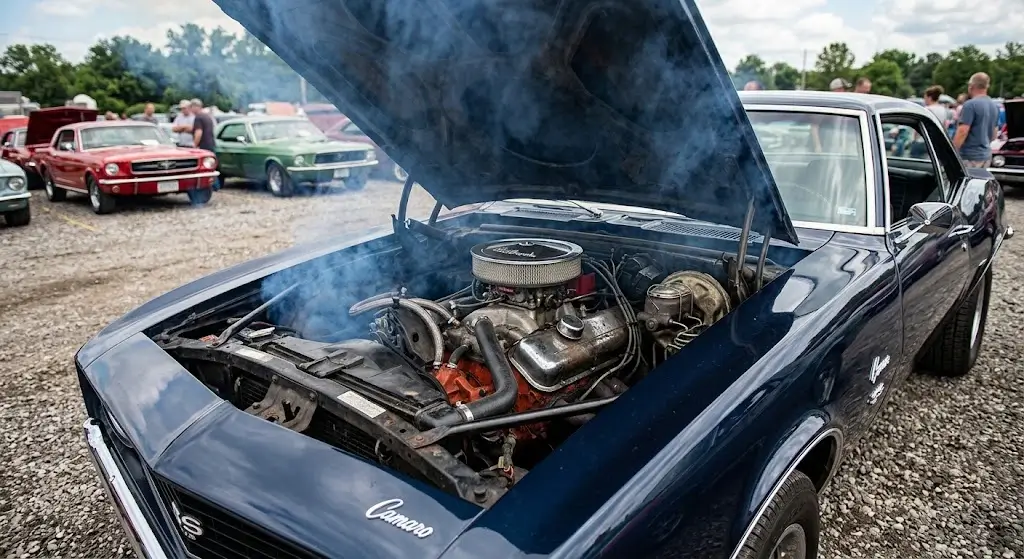
Exhaust color helps narrow the possible causes, but it cannot confirm a diagnosis by itself.
Blue or blue-gray smoke
Blue smoke means oil is entering the combustion chamber.
Possible causes include:
- PCV-system malfunction
- Worn valve-stem seals or valve guides
- Worn piston rings
- Damaged cylinder walls
Smoke mainly during startup or deceleration may point toward valve seals or guides. Persistent smoke under acceleration may be more consistent with ring or cylinder wear.
Black smoke
Black smoke generally indicates excessive fuel or insufficient air.
Inspect:
- Choke operation
- Carburetor float level
- Fuel pressure
- Needle and seat
- Air-filter restriction
- Carburetor adjustment
Black smoke is normally a fuel-mixture problem, not direct evidence that the engine needs rebuilding.
White smoke or vapor
Light vapor during a cold start can be normal condensation.
Persistent white smoke after the engine is warm—especially with coolant loss or a sweet odor—may indicate coolant entering a cylinder through a damaged head gasket, cracked cylinder head, or another internal leak.
Learn more about diagnosing head-gasket failure in classic cars.
Overheating and Cooling-System Problems
First confirm that the engine is actually overheating. An inaccurate gauge, incompatible sending unit, weak electrical ground, or wiring problem can produce a false reading.
If the temperature is verified, inspect:
- Coolant level and external leaks
- Radiator airflow and internal flow
- Fan, fan clutch, and shroud
- Thermostat operation
- Water pump and belt tension
- Radiator-cap pressure
- Lower radiator hose
- Ignition timing
- Fuel mixture
Overheating may result from a restricted radiator, inadequate airflow, a faulty thermostat, a slipping belt, incorrect ignition timing, a lean fuel mixture, or insufficient coolant circulation.
It is more likely to involve internal engine damage when accompanied by coolant-contaminated oil, persistent white smoke, combustion gases in the cooling system, compression loss, or warped sealing surfaces.
Overheating alone is not sufficient evidence that an engine needs rebuilding.
Oil Leaks and Incorrect Oil-Pressure Readings
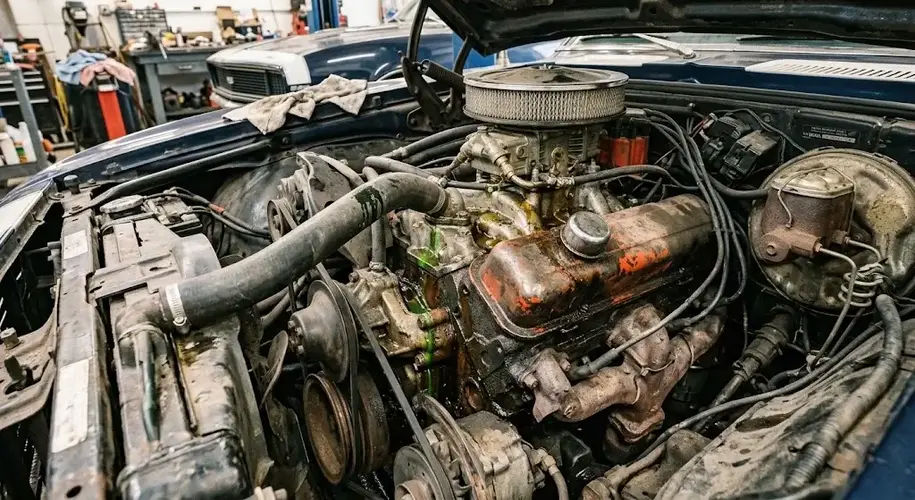
External oil leaks do not prove that an engine has serious internal wear.
Common leak sources include:
- Valve-cover gaskets
- Oil-pan gasket
- Front and rear engine seals
- Oil-pressure sending unit
- Oil filter or filter adapter
- Crankcase ventilation system
A low dashboard oil-pressure reading must also be verified before internal damage is assumed.
Check:
- Oil level and condition
- Correct oil viscosity
- Gauge and sending unit
- Wiring and electrical grounds
- Actual pressure using a mechanical gauge
Confirmed low oil pressure when the engine is hot may indicate oil-pump wear, restricted oil flow, crankshaft-journal wear, or excessive bearing clearances.
A leaking gasket or inaccurate sending unit may require repair, but neither condition by itself means the engine needs a complete rebuild.
How to Diagnose a Classic-Car Engine Systematically
1. Verify the symptom
Determine whether the problem occurs:
- When the engine is cold or hot
- At idle or under load
- At a specific engine or vehicle speed
- Constantly or intermittently
- Suddenly or gradually
This helps separate ignition, fuel, cooling, drivetrain, electrical, and internal engine problems.
2. Inspect external components
Check fluid levels, leaks, vacuum hoses, wiring, grounds, belts, linkages, fuel lines, accessory brackets, exhaust connections, and loose components.
This initial inspection may reveal a correctable fault without requiring internal engine testing or disassembly.
3. Test the related systems
Depending on the symptom, evaluate:
- Spark quality
- Ignition timing and advance
- Carburetor operation
- Fuel pressure and volume
- Intake airflow
- Vacuum readings
- Cooling-system operation
- Mechanical oil pressure
- Exhaust flow
The tests should follow the symptom. For example, a misfire requires different initial checks than overheating or an incorrect oil-pressure reading.
4. Test internal engine condition
If external systems do not explain the problem, testing may include:
- Compression testing
- Leak-down testing
- Vacuum-gauge testing
- Oil-filter inspection
- Borescope inspection
- Cooling-system pressure testing
- Combustion-gas testing
There is no universal healthy compression PSI for every classic engine. Results depend on engine design, camshaft timing, cranking speed, temperature, altitude, and testing conditions.
For the correct procedure, read How to Do a Compression Test on a Classic Car Engine.
When Troubleshooting Should Progress to Internal Testing
If ignition, fuel, cooling, exhaust, drivetrain, and external mechanical checks do not explain the problem, proceed to internal testing.
Compression, leak-down, mechanical oil-pressure, borescope, and oil-filter findings can help determine whether the fault is limited to one component or reflects broader internal wear.
A single failed component may be repairable without rebuilding the complete engine. For example, diagnosis may identify:
- A leaking valve
- Incorrect valve adjustment
- A localized head-gasket failure
- A worn timing component
- A damaged valvetrain component
- An oil-pump problem
This article is intended to help eliminate common external and system-related causes.
If rebuilding is confirmed, use our engine rebuild versus replacement guide to evaluate the next step.
Frequently Asked Questions
What should I check first when a classic engine runs rough?
Start with the spark plugs, ignition timing, carburetor operation, fuel delivery, electrical grounds, and vacuum leaks. Test internal compression if these systems do not explain the problem.
Can classic-car engine problems be fixed without rebuilding?
Yes. Ignition faults, carburetor problems, vacuum leaks, cooling-system failures, valve-adjustment issues, inaccurate gauges, and loose external components can often be corrected without rebuilding.
Does knocking always indicate internal engine damage?
No. Detonation, exhaust leaks, accessories, valvetrain components, and loose flexplate or torque-converter bolts can create similar noises. The source should be identified before the engine is disassembled.
Does smoke mean a classic-car engine needs rebuilding?
Not necessarily. Black smoke is generally related to excessive fuel, while temporary white vapor may be condensation. Blue smoke can result from a PCV-system problem or valve-seal wear as well as piston-ring or cylinder wear.
When should compression testing be performed?
Compression testing is appropriate when misfires, power loss, hard starting, smoke, or other symptoms remain after basic ignition, fuel, electrical, and external checks.
Can low oil pressure be caused by the gauge?
Yes. A faulty sending unit, wiring problem, incompatible gauge, or poor electrical ground can produce an inaccurate reading. Actual pressure should be checked with a mechanical gauge before internal wear is diagnosed.
Diagnose the Cause Before Rebuilding
Classic-car engine problems should be traced to their source before major work is recommended.
A rough idle may require ignition service, a knock may come from an external component, and power loss may result from restricted fuel delivery rather than internal wear.
At Coastline Classic Car Restorations in Huntington Beach, we evaluate the complete mechanical system before recommending an engine rebuild.
If your classic car has unresolved engine noise, smoke, overheating, poor performance, or starting problems, request a professional evaluation or explore our classic-car engine rebuilding and restoration services.