

A classic-car engine may need rebuilding when multiple findings indicate widespread internal wear that cannot be corrected reliably with a limited repair.
The strongest indicators include low compression across several cylinders, excessive blow-by, persistent oil consumption, verified low hot oil pressure, metal in the oil filter, and deep internal knocking.
These findings are different from general drivability symptoms.
Rough idle, hard starting, power loss, smoke, or overheating may originate outside the engine and do not confirm that rebuilding is necessary.
A rebuild recommendation should be supported by compression testing, leak-down testing, mechanical oil-pressure testing, oil-filter inspection, or other evidence of internal wear.
When Does a Classic-Car Engine Need Rebuilding?
An engine becomes a rebuild candidate when wear or damage affects multiple internal components or when restoring the correct clearances and sealing requires substantial disassembly and machine work.
Components commonly evaluated include:
- Piston rings and cylinder walls
- Main and connecting-rod bearings
- Crankshaft journals
- Pistons and wrist pins
- Camshaft and lifters
- Valve guides and sealing surfaces
- Oil pump and lubrication passages
The final scope may not be known until the engine is disassembled, cleaned, measured, and inspected.
1. Persistent Blue Smoke and Oil Consumption
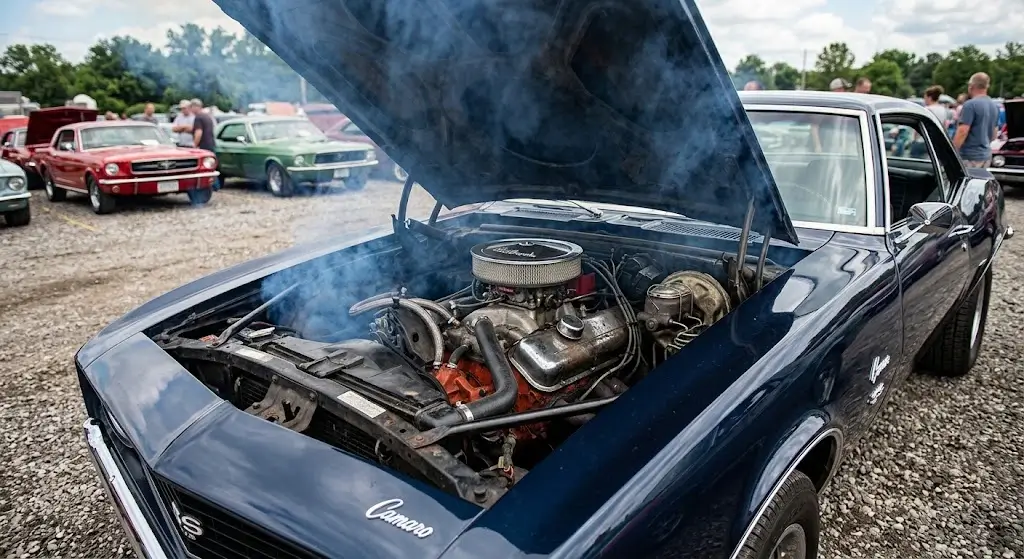
Blue or blue-gray exhaust smoke usually means oil is entering the combustion chamber.
Possible internal sources include:
- Worn piston rings
- Damaged cylinder walls
- Worn valve guides
- Failing valve-stem seals
Blue smoke alone does not mean the complete engine needs rebuilding. Valve seals or cylinder-head components may sometimes be repaired separately.
A rebuild becomes more likely when persistent blue smoke is accompanied by:
- Measurable oil consumption
- Excessive crankcase pressure
- Oil-fouled spark plugs
- Low compression
- Leak-down air entering the crankcase
Smoke mainly during startup or deceleration may point toward valve-seal or valve-guide wear.
Persistent smoke under acceleration, especially when combined with blow-by and ring leakage, provides stronger evidence of piston-ring or cylinder-wall wear.
External leaks should be ruled out before determining how much oil the engine is consuming internally.
2. Excessive Blow-By or Crankcase Pressure
Blow-by occurs when combustion gases escape past the piston rings and enter the crankcase.
Possible signs include:
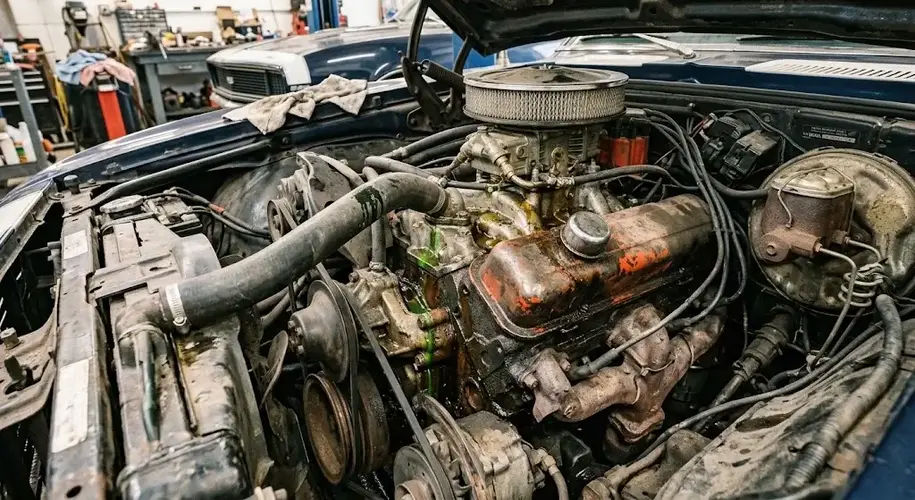
- Heavy vapor from the crankcase breather
- Oil pushed from seals or the dipstick tube
- Oil collecting in the air cleaner
- Increasing oil leaks
- Continuing oil consumption
A restricted or defective PCV system can produce similar symptoms and should be inspected first.
Excessive blow-by becomes rebuild-level evidence when testing confirms leakage past the piston rings.
Correcting the condition may require cylinder honing or boring, new piston rings, replacement pistons, or cylinder-wall repair.
When multiple cylinders have significant ring leakage, broader rebuilding may be more appropriate than a limited repair.
3. Deep Internal Knocking
A deep, rhythmic knock that changes with engine speed or load may indicate excessive clearance or damage involving:
- Connecting-rod bearings
- Main bearings
- Crankshaft journals
- Pistons or wrist pins
- The lubrication system
Noise alone does not confirm internal engine damage.
The source must be identified because detonation, accessories, exhaust leaks, valvetrain components, and loose drivetrain parts can create similar sounds.
A rebuild becomes more likely when a deep internal knock is accompanied by:
- Bearing material in the oil filter
- Increasing noise as the engine warms
- Excessive bearing clearance
- Crankshaft-journal damage
Stop operating the engine until the source is identified. Continuing to run an engine with confirmed bearing knock can damage the crankshaft, connecting rods, and block.
For broader noise troubleshooting, read Common Classic Car Engine Problems: What to Check Before Rebuilding.
4. Low Hot Oil Pressure
Oil pressure changes with engine speed, temperature, viscosity, and engine design.
A low dashboard reading must be verified before it is considered evidence of internal wear.
Actual pressure should be checked with an accurate mechanical gauge and compared with the specifications for that engine.
Verified low oil pressure after the engine reaches normal operating temperature may indicate:
- Worn main or connecting-rod bearings
- Excessive bearing clearances
- Worn crankshaft journals
- Oil-pump wear
- A damaged or restricted oil-pump pickup
- Internal oil leakage
Before recommending rebuilding, confirm the correct oil level and viscosity and verify that the filter, oil pump, pickup, and pressure reading are reliable.
Low hot oil pressure combined with knocking or bearing material is much stronger evidence of internal wear than a dashboard reading alone.
5. Low Compression Across Multiple Cylinders
Compression testing measures how effectively each cylinder seals while the engine is cranking.
Low compression may be caused by:

- Worn piston rings
- Cylinder-wall wear
- Leaking valves
- Worn camshaft lobes
- Piston damage
- Head-gasket failure
- Incorrect valve adjustment or timing
One low cylinder may indicate a localized problem. Two adjacent low cylinders may suggest a gasket leak.
Low readings across several cylinders are more concerning because they can indicate widespread ring, cylinder, valve, or camshaft wear.
There is no universal healthy PSI range for every classic engine.
Results are affected by the engine design, compression ratio, camshaft timing, cranking speed, temperature, altitude, and testing procedure.
Compression results should be supported by leak-down testing. Air entering the crankcase may indicate ring or cylinder leakage, while air heard at the intake or exhaust may point toward a valve problem.
For the complete procedure, read How to Perform and Interpret a Compression Test on a Classic Car Engine.
6. Metal in the Engine Oil or Oil Filter
Metallic debris in the oil or filter may provide physical evidence of abnormal internal wear.
The type of material may offer clues:
- Copper or bronze-colored material may come from bearings or bushings.
- Ferrous particles may come from cylinder walls, camshaft lobes, lifters, or timing components.
- Aluminum may come from pistons or other aluminum components.
The oil filter should be opened and inspected properly. Oil analysis may also help identify the material and its potential source.
Metal becomes a serious rebuild indicator when accompanied by:
- Deep internal knocking
- Falling oil pressure
- Increasing mechanical noise
- Continuing debris
- Bearing or cylinder damage
Stop operating the engine until the source has been identified. Circulating metallic debris can damage other components through the lubrication system.
7. Overheating With Confirmed Internal Damage
Overheating alone does not mean an engine needs rebuilding. Many overheating problems begin in the cooling, ignition, or fuel system.
Severe or repeated overheating can nevertheless cause:
- Warped cylinder heads
- Head-gasket failure
- Damaged piston rings
- Scored cylinder walls
- Bearing damage
- Coolant-contaminated oil
- Cracked castings
- Distorted sealing surfaces
A cylinder-head or head-gasket repair may be sufficient if the damage remains localized and the bottom end is healthy.
Rebuilding becomes more likely when overheating has caused compression loss across multiple cylinders, lubrication failure, damaged rings or cylinder walls, bearing damage, or several damaged internal components.
If overheating occurs with persistent white smoke, unexplained coolant loss, bubbles in the cooling system, or contaminated oil, review Head Gasket Failure in Classic Cars: Symptoms, Diagnosis and Repair.
When Multiple Signs Point Toward Rebuilding
Rebuild decisions should rarely be based on one isolated symptom. Related findings create a stronger indication of widespread internal wear.
Examples include:
- Blue smoke, oil consumption, blow-by, and confirmed ring leakage
- Deep knocking, low hot oil pressure, and bearing material
- Low compression across multiple cylinders with declining performance
The more evidence that points toward the same internal components, the stronger the case for disassembly and inspection.
Tests That Help Confirm Internal Wear
A professional evaluation may include:
- Compression test: Identifies low or inconsistent cylinder pressure.
- Leak-down test: Locates leakage past valves, rings, or a head gasket.
- Mechanical oil-pressure test: Verifies actual pressure when the engine is hot.
- Oil-filter inspection: Checks for bearing material and metallic debris.
- Blow-by evaluation: Assesses combustion leakage into the crankcase.
- Cooling-system tests: Identify internal coolant leaks and combustion gases.
No single test evaluates the entire engine. Results should be considered with the engine’s noise, oil consumption, temperature history, maintenance records, and specifications.
When a Smaller Repair May Be Enough
A complete rebuild may not be necessary when testing isolates the problem to a valve, cylinder-head component, head gasket, oil pump, timing component, or another limited area.
The decision depends on the condition of the rest of the engine, the labor required to reach the damaged component, parts availability, and the vehicle’s restoration goals.
If internal damage has not been confirmed, begin with common classic-car engine problems to check before rebuilding.
When Should You Stop Driving?
Stop operating the vehicle if you experience:
- Deep or rapidly worsening knocking
- Sudden loss of oil pressure
- Metal in the oil or filter
- Severe overheating
- Coolant mixed with engine oil
- Heavy smoke with rapid oil consumption
- An engine that begins to seize
Continuing to drive can turn repairable wear into crankshaft, piston, cylinder-wall, connecting-rod, or engine-block damage.
Frequently Asked Questions
Does low compression always mean the engine needs rebuilding?
No. Low compression can result from a valve problem, incorrect adjustment, head-gasket failure, piston damage, or ring and cylinder wear. Additional testing is required.
Is engine knocking always caused by internal damage?
No. Some noises originate from detonation, accessories, valvetrain components, exhaust leaks, or loose drivetrain parts. Deep knocking with low oil pressure or metal debris is more concerning.
Can an engine be repaired without a complete rebuild?
Yes. Cylinder-head, gasket, valvetrain, oil-pump, and other localized problems may sometimes be repaired separately.
Is one warning sign enough to approve a rebuild?
Usually not. A rebuild recommendation should be supported by test results, physical evidence, or multiple related findings.
Should I drive after finding metal in the oil?
No. Stop operating the engine until the source of the material has been identified.
Confirm the Engine’s Condition Before Rebuilding
An engine rebuild should be recommended because testing confirms widespread internal wear—not simply because an older engine smokes, runs poorly, overheats, or makes noise.
With more than 14 years of experience working on classic vehicles, Coastline Classic Car Restorations in Huntington Beach evaluates test results, mechanical condition, engine originality, previous repairs, and restoration goals before recommending major work.
Explore our classic-car engine rebuilding and restoration services or request an evaluation.
Once rebuilding is confirmed, review our engine rebuild versus replacement guide to determine whether restoring the existing engine or installing another engine is the better choice.