

Quick Answer
How do you read a classic car wiring diagram?
Start at the power source (battery), follow the circuit path to the component, and trace it to ground—while verifying voltage, continuity, and resistance using a multimeter.
Important Truth Before You Start
A wiring diagram is not a live map of your car.
It shows how the vehicle was wired when it left the factory decades ago.
Your car today may have:
- Corroded connections
- Modified wiring
- Replaced components
- Rerouted circuits
Always test the circuit in real conditions—not just what the diagram shows.
How to Read a Classic Car Wiring Diagram (Step-by-Step)
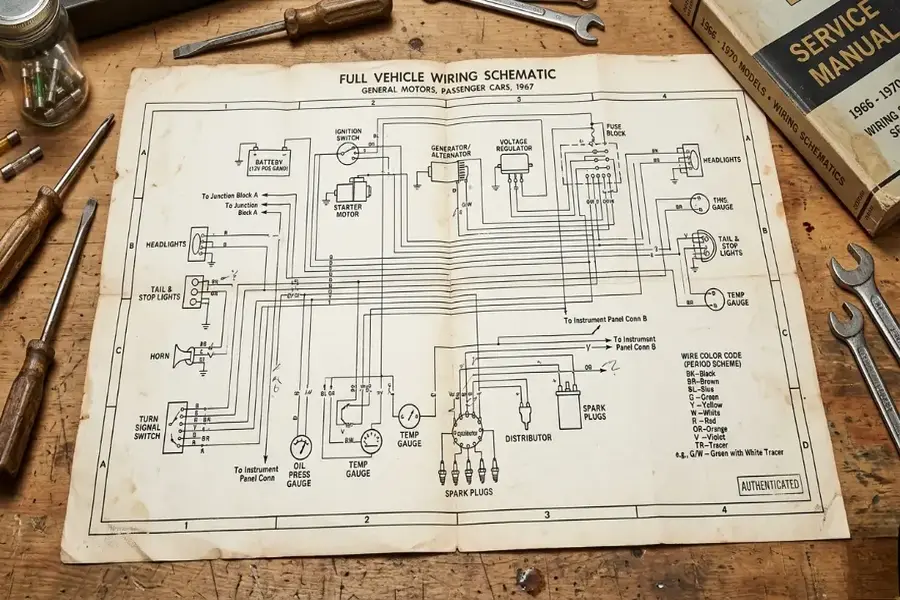
Follow electrical flow (power → component → ground), understand symbols, and verify each part of the circuit with testing tools.
Step 1: Start at the Power Source
- Battery
- Ignition switch
This is where voltage originates.
Step 2: Follow the Circuit Path
Think in sequence:
Battery → Switch → Component → Ground
Focus on electrical flow, not physical layout.
Step 3: Understand Wiring Symbols
Symbols represent electrical functions and are consistent across diagrams.
Common components:
- Switches
- Relays
- Grounds
- Connectors
Symbols are more reliable than wire colors.
Step 4: Ignore Wire Colors
Wire colors become unreliable due to:
- Heat degradation
- Corrosion
- Previous repairs
Always verify wires using tools—not visual assumptions.
Step 5: Test the Circuit (Critical)
Use:
- Multimeter (Learn the specifics of how to use a multimeter for automotive work)
- Test light
Check:
- Voltage
- Continuity
- Ground integrity
Real-world measurements always override the diagram.
Core Electrical Concepts
These are essential to understand wiring behavior:
- Voltage: Electrical pressure that pushes current through a circuit
- Current: The flow of electricity through wires and components
- Resistance: Opposition to current flow, often caused by corrosion or poor connections
- Continuity: A complete path that allows electricity to flow
- Electrical Load: Any component (like lights or motors) that consumes power
When any of these are disrupted, electrical problems occur.
Why Wiring Diagrams Don’t Match Your Car
Because your vehicle has changed over time due to wear, repairs, and modifications, making the original diagram inaccurate.
What Changes Over Time?
Classic cars often have:
- Previous owner modifications
- Engine swaps (LS, HEI, EFI systems)
- Corroded wiring
- Aftermarket accessories
The diagram stayed the same—your car didn’t.
Common Wiring Frustrations
You may have experienced:
- Wire colors don’t match
- Circuits behave unpredictably
- Components fail despite correct wiring
This is not user error—it’s real-world electrical deviation.
The Hidden Problem: “Ghost Grounds”
Why do headlights dim when braking?
Poor grounding increases resistance, causing voltage to be pulled from other circuits.
What’s Actually Happening
- Ground points corrode
- Resistance increases
- Voltage drops under load
Result:
- Dim lights
- Flickering
- Electrical interference
Diagrams assume perfect ground—real cars rarely have it.
The 1-Wire Ground Test
Run a temporary wire from the component directly to battery negative.
Results:
- Problem disappears → Bad ground
- Problem remains → Issue lies elsewhere
This isolates grounding issues instantly.
What a Wiring Diagram Actually Shows
A wiring diagram shows intended electrical design—not real-world performance.
It shows:
- Power sources
- Circuit paths
- Switches and relays
- Ground points
It does NOT show:
- Corrosion
- Resistance
- Loose connections
- Electrical load issues
Why Is My 12V Wire Showing Only 9V?
Voltage drop caused by resistance in the circuit.
What Causes Voltage Drop?
- Corrosion
- Loose connections
- Damaged wires
Result:
- Weak performance
- Intermittent failure
- Electrical instability
Test Light vs Multimeter
A multimeter is essential for accurate diagnostics. If you’ve never used one, getting familiar with the multimeter’s settings is the first step toward professional troubleshooting.
Test Light
✔ Quick checks
✔ Detects power presence
Multimeter
✔ Measures voltage
✔ Tests continuity
✔ Detects voltage drop
Professionals rely on multimeters for real diagnostics.
How to Find a Short Circuit Without Blowing Fuses
Replace the fuse with a sealed beam headlight.
Why It Works:
- Limits current
- Prevents fuse failure
- Lights up when a short is present
How Professionals Diagnose Wiring Problems
Professionals verify reality—not diagrams.
Methods:
- Continuity testing
- Voltage drop testing
- Load testing
These reveal hidden electrical issues.
Red Flags to Check Immediately
- Blue Scotchlok connectors
- Old electrical tape
- Random splices
These often indicate the true problem.
Common Wiring Diagram Symbols (Quick Guide)
- Ground symbol: Connection to chassis or battery negative
- Switch: Opens or closes a circuit
- Relay: Electrically controlled switch
- Connector: Junction between wires
Learning symbols improves diagram reading more than memorizing colors.
Why Coastal Cars (Orange County)Have More Electrical Problems
Salt air causes:
- Corrosion
- Increased resistance
- Faster wiring degradation
Coastal environments accelerate electrical failure.
Wiring Repair vs Full Restoration
When repairs fail:
- Problems repeat
- System becomes unstable
Full restoration provides:
- Clean circuits
- Stable voltage
- Long-term reliability
Frequently Asked Questions
How do you read a wiring diagram correctly?
Follow power to component to ground and verify each step with testing tools.
Why doesn’t my wiring diagram match my car?
Because your car has been modified or degraded over time.
Can I trust a wiring diagram?
Only as a reference—not real-world accuracy.
What causes voltage drop?
Resistance from corrosion, loose connections, or damaged wiring.
What tool is best for diagnostics?
A multimeter can provide the most accurate results.
Final Truth
Your wiring diagram shows the past.
Your car reflects years of change.
The more age and modifications → the less accurate the diagram becomes.
Expert Classic Car Electrical Diagnosis in Huntington Beach
If you’re stuck chasing wiring problems:
It’s time for real diagnostics—not guesswork.
At Coastline Classic Car Restorations in Huntington Beach, we specialize in:
- Electrical troubleshooting
- Wiring restoration
- Custom harness builds
Contact us today to fix the problem at its source — or learn more about our classic car electrical wiring repair services.