

Electric fan conversions can improve a classic car’s cooling at idle and in traffic because they provide airflow independently of engine RPM.
However, a conversion will help only when insufficient low-speed airflow is the actual limitation.
An electric fan cannot correct a restricted radiator, inadequate coolant circulation, cooling-system pressure loss, improper engine tuning, or internal engine damage.
A successful conversion also requires the correct fan capacity, shroud, mounting position, temperature control, wiring, circuit protection, and charging-system output.
For more information about low-speed cooling problems, read Why Classic Cars Overheat in Traffic.
Mechanical Fans vs. Electric Fans
A mechanical fan is driven by the engine through a belt and pulley. An electric fan is powered by the vehicle’s electrical system and controlled by a switch, relay, or electronic controller.
| Attribute | Mechanical fan | Electric fan |
|---|---|---|
| Drive source | Engine and belt | Electrical system |
| Low-speed airflow | Depends on engine RPM, fan design and clutch engagement | Can operate independently of engine RPM |
| Electrical demand | Minimal direct demand | May require substantial current |
| Engine load | Direct mechanical load | Indirect load through the alternator |
| Temperature control | Fixed or clutch-controlled | Temperature switch or electronic controller |
| Originality | Usually factory-correct | Usually considered a modification |
| Common failure points | Belt, clutch, blade or mounting | Motor, relay, controller, fuse, wiring or charging system |
A properly designed mechanical fan can provide strong idle cooling when paired with the correct pulley ratio, blade design, fan clutch, position, and shroud.
Converting to electric is not automatically an improvement if the original setup already meets the engine’s cooling requirements.
What Does an Electric Fan Conversion Include?
A complete electric-fan conversion involves more than attaching a fan to the radiator.
Depending on the vehicle, the system may require:

- Electric fan or dual-fan assembly
- Full or partial fan shroud
- Temperature switch or sensor
- Relay or electronic controller
- Correctly sized power and ground wiring
- Fuse or circuit breaker
- Mounting brackets
- Manual override, if appropriate
- Charging-system evaluation
The fan should activate at a temperature suitable for the engine and thermostat. The control system should also prevent excessive cycling, voltage loss, overheated wiring, and unintended battery drain.
Plastic fasteners that pass directly through the radiator core may be unsuitable for long-term use in some applications because vibration and load can damage the fins or tubes.
A rigid mounting system that transfers the fan’s weight to the radiator support or approved mounting points is generally preferable.
When Does an Electric Fan Improve Cooling?
An electric fan is most likely to help when:
- The engine overheats mainly at idle or low vehicle speed
- Temperature stabilizes once the vehicle begins moving
- The mechanical fan does not produce enough low-speed airflow
- The radiator and coolant-circulation system are functioning correctly
- The engine is properly tuned
- The charging system can support the additional current
- Available space allows an effective fan and shroud
This behavior may indicate that the radiator can remove sufficient heat when airflow is available but receives too little airflow while the vehicle is stationary.
Before converting, confirm the cooling limitation using the process in How to Fix Classic Car Overheating in Traffic.
When Will an Electric Fan Not Fix Overheating?
An electric fan will not correct overheating caused by:
- Internal radiator restriction
- Worn or incorrect water pump
- Collapsing lower radiator hose
- Thermostat failure
- Trapped air
- Coolant loss
- Weak radiator cap or pressure leak
- Incorrect ignition timing
- Lean air-fuel mixture
- Internal engine damage
- Cooling capacity that is insufficient at all speeds
If the radiator cannot transfer heat or coolant cannot circulate correctly, increasing airflow alone will not solve the problem.
When the radiator is the confirmed limitation, review Radiator Upgrades for Classic Cars.
Why the Fan Shroud Matters
Fan performance depends on how effectively air is drawn through the radiator—not only on the fan’s advertised airflow rating.
A properly designed shroud helps the fan draw air through a larger and more useful portion of the radiator core.
Without effective shrouding, the fan may pull air primarily through the area directly in front of its blades.
Important airflow considerations include:
- Fan coverage of the radiator core
- Shroud depth and shape
- Fan-to-core spacing
- Openings around the shroud
Radiator seals and side baffles - Grille restrictions
- Air-conditioning condenser placement
- Space for hot air to exit the engine compartment
A powerful fan can perform poorly if the shroud restricts airflow or allows excessive air recirculation.
Puller vs. Pusher Electric Fans
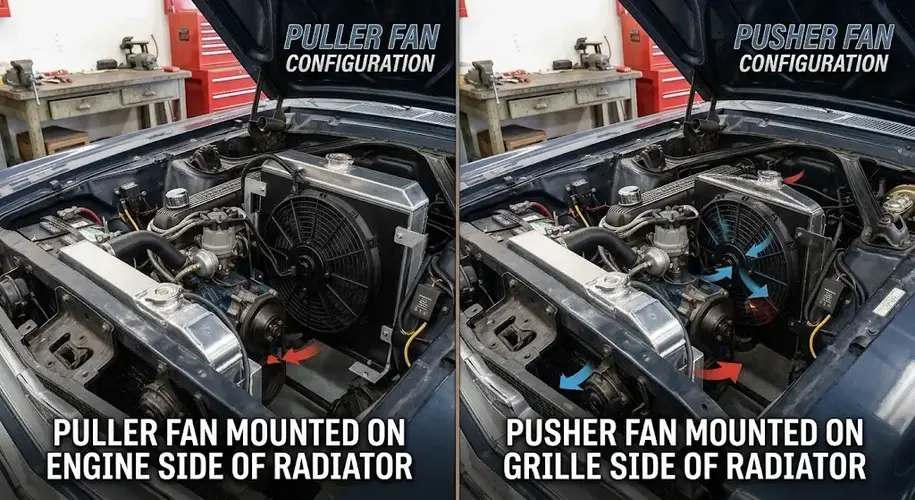
A puller fan mounts behind the radiator and draws air through the core. A pusher fan mounts in front and pushes air through it.
Puller fan
A puller configuration is generally preferred when sufficient space exists because it:
- Usually interferes less with natural road airflow
- Can be paired with an effective rear shroud
- Draws heated air toward the engine compartment
- Often provides better radiator-core coverage
- Pusher fan
A pusher fan may be appropriate when:
- Engine-side clearance is limited
- The mechanical fan is being retained
- The electric fan is used as an auxiliary unit
- Vehicle packaging prevents a puller installation
A pusher fan is not automatically ineffective. Its performance depends on fan design, radiator coverage, airflow restriction, available space, and mounting quality.
Can the Electrical System Support an Electric Fan?
Electric fans can place a significant load on a classic car’s charging system, especially when operating at idle with headlights, air conditioning, ignition, and other accessories running.
The electrical evaluation should consider:
- Fan running current
- Startup or inrush current
- Alternator output at idle
- Existing accessory load
- Battery condition
- Charging-cable capacity
- Ground quality
- Relay and fuse ratings
- Wire gauge and length
- Connector temperature rating
Alternator output at idle is particularly important because the fan may run when engine and alternator speeds are lowest.
A larger alternator is not automatically required. The correct decision should be based on measured electrical demand and available charging output.
If demand exceeds supply, voltage may fall, fan speed may decrease, wiring may overheat, and battery discharge may occur.
The fan motor should not be powered directly through a dashboard switch. A relay or properly designed controller should carry the main current, with suitable circuit protection installed near the power source.
Temperature Switches and Variable-Speed Controllers
A basic fan system uses a temperature switch and relay to turn the fan on and off at specified temperatures.
More advanced controllers may use pulse-width modulation or variable-speed operation to:
- Match fan speed to cooling demand
- Reduce abrupt current changes
- Limit unnecessary fan noise
- Reduce repeated full-speed cycling
- Support staged dual-fan operation
Controller reliability depends on component quality, wiring, grounding, heat protection, sensor placement, and installation—not merely on the control method.
Should You Convert Your Classic Car to an Electric Fan?
Consider converting when:
- Low-speed airflow is confirmed as insufficient
- The radiator and coolant-flow system are functional
- The electrical system can support the fan
- Correct mounting and shrouding are possible
- The vehicle regularly operates in traffic
- Low-speed reliability matters more than strict originality
Retain the mechanical fan when:
- It provides adequate airflow
- The correct fan, clutch, pulley, and shroud are available
- Factory appearance is important
- Electrical capacity is limited
- The vehicle is primarily a collector or show car
Do not convert yet when:
- The overheating cause has not been diagnosed
- The radiator is internally restricted
- Coolant circulation is inadequate
- The engine is improperly tuned
- The available fan cannot cover enough of the radiator
- The charging system cannot support the added load
Electric fans should be selected as part of a complete cooling strategy—not as an automatic replacement for a properly functioning mechanical fan.
Electrical Reliability in Coastal Environments
Moisture and salt air in coastal areas such as Huntington Beach can accelerate corrosion at electrical connections.
A dependable installation should include:
- Sealed or weather-resistant connectors
- Protected relay and fuse terminals
- Clean engine, body, and battery grounds
- Correct strain relief
- Heat-resistant wiring near the engine
- Periodic inspection for corrosion or loose connections
Some controllers allow the fan to run briefly after shutdown.
This may reduce radiator and underhood temperature, but its ability to cool the engine is limited when the water pump is no longer circulating coolant.
Frequently Asked Questions
Do electric fans improve cooling in classic cars?
Yes, when insufficient low-speed airflow is the cooling limitation and the rest of the system functions correctly.
Will an electric fan fix overheating in traffic?
It may, but only after radiator restriction, coolant-flow problems, pressure loss, and engine-tuning issues have been ruled out.
Is a puller fan better than a pusher fan?
A puller fan is generally preferred when space allows, but a correctly selected pusher fan can work in applications with limited engine-side clearance.
Does an electric fan require a larger alternator?
Not always. Compare the fan’s current demand and existing electrical loads with the alternator’s output, particularly at idle.
Should I remove the mechanical fan?
Only when the electric system can provide sufficient airflow under all intended driving conditions. Some vehicles use an auxiliary electric fan while retaining the mechanical fan.
Will an electric fan affect originality?
Usually yes. Owners of collector vehicles may prefer to retain the factory fan system or use reversible modifications while preserving the original components.
Final Answer
Electric fan conversions can improve classic-car cooling when insufficient airflow at idle or low vehicle speed is the confirmed limitation.
A successful conversion requires:
- Correct fan capacity
- Effective radiator coverage
- Proper shrouding
- Adequate electrical output
- Correct wiring and circuit protection
- Reliable temperature control
- Compatibility with the radiator and vehicle layout
At Coastline Classic Car Restorations in Huntington Beach, we evaluate the complete cooling system—including airflow, radiator efficiency, coolant circulation, electrical capacity, vehicle use, and originality goals—before recommending a fan conversion.
Learn more about our classic car cooling system restoration services.