

Classic car upholstery restoration can take one to three business days for a localized seam repair and one to two weeks for a pair of seats.
A complete upholstery package, including seats, upholstered panels, and the headliner, typically requires four to eight weeks of active work.
Factory-correct or custom projects may take several months when they require rare materials, hand-built foam, structural seat repairs, custom patterns, or repeated test fitting.
These are broad planning ranges—not guaranteed Coastline Classic Car Restorations turnaround times.
The actual schedule depends on the vehicle’s condition, material availability, project scope, and the shop’s scheduled start date.
Classic Car Upholstery Timelines at a Glance

| Upholstery project | Broad working-time range | Typical work involved |
|---|---|---|
| Localized seam or piping repair | 1–3 business days | Opening the affected area, re-stitching, reinforcing, and refitting |
| Single-seat foam or cover work | 3–7 business days | Cover removal, cushion repair, fitting, and reinstallation |
| Front-seat pair | 1–2 weeks | Covers, foam, support repairs, and final alignment |
| Headliner restoration | 1–5 business days | Bow-style installation or headliner-board recovery |
| Door and quarter panels | 1–3 weeks | Board repair, patterning, covering, and trim transfer |
| Complete upholstery package | 4–8 weeks | Seats, upholstered panels, headliner, and related soft trim |
| Factory-correct or custom upholstery | 2–4 months or longer | Research, sourcing, fabrication, and repeated test fitting |
The total calendar time may be longer than the active working time if materials must be ordered or the project is waiting for its scheduled production date.
Does the Timeline Begin When the Vehicle Is Dropped Off?
Not necessarily. Upholstery projects usually involve more than one type of timeline:
Booking time: The wait before the shop has an available production slot.
Material lead time: Time needed to order upholstery, foam, trim, and hardware.
Inspection and disassembly: The stage when hidden damage becomes visible.
Active restoration time: Repairing, patterning, sewing, padding, and installation.
Final fitting: Adjusting seams, trim, hardware, and component operation.
A project described as requiring two weeks of work may take longer from approval to delivery if the covers, foam, or period-correct material have not arrived.
For that reason, materials and major replacement components should ideally be confirmed before the vehicle enters active production.
How Long Does Upholstery Re-Stitching Take?
A localized seam or piping repair may take approximately one to three business days after work begins, provided the surrounding material remains strong enough to reuse.
The repair may take longer when:
- The seat must be removed
- The entire cover must come off to reach the seam
- Thread has failed across multiple panels
- Piping or an insert also requires replacement
- The material has shrunk or become brittle
- Matching thread or upholstery must be sourced
- Collapsed foam has pulled the seam out of alignment
A small visible opening is not always a simple stitching repair. New thread cannot create a lasting repair when the leather, vinyl, or cloth tears beside the original needle holes.
The material around the damaged seam should therefore be evaluated before a completion date is promised.
How Long Does Seat Foam and Support Restoration Take?
Restoring the foam and support system in one classic car seat may take approximately three to seven business days.
A pair of front seats commonly requires one to two weeks, particularly when the springs, straps, frame, or tracks also need repair.
The work may involve:
- Removing and documenting the original cover
- Inspecting the frame, springs, and support straps
- Repairing burlap or protective layers
- Fitting model-specific molded foam
- Hand-building unavailable cushion contours
- Correcting bolster height
- Restoring listing wires and attachment points
- Refitting the upholstery
Model-specific foam can shorten the process when it fits correctly. Hand-shaped foam or traditional padding takes longer because the seat must be rebuilt gradually and compared with its original profile.
Broken springs, cracked welds, rusted tracks, or failed rubber supports must be corrected before the cushion is finalized.
Installing new foam over damaged support components may produce an uneven seat and require the upholstery to be removed again.
How Long Does It Take to Fit New Seat Covers?
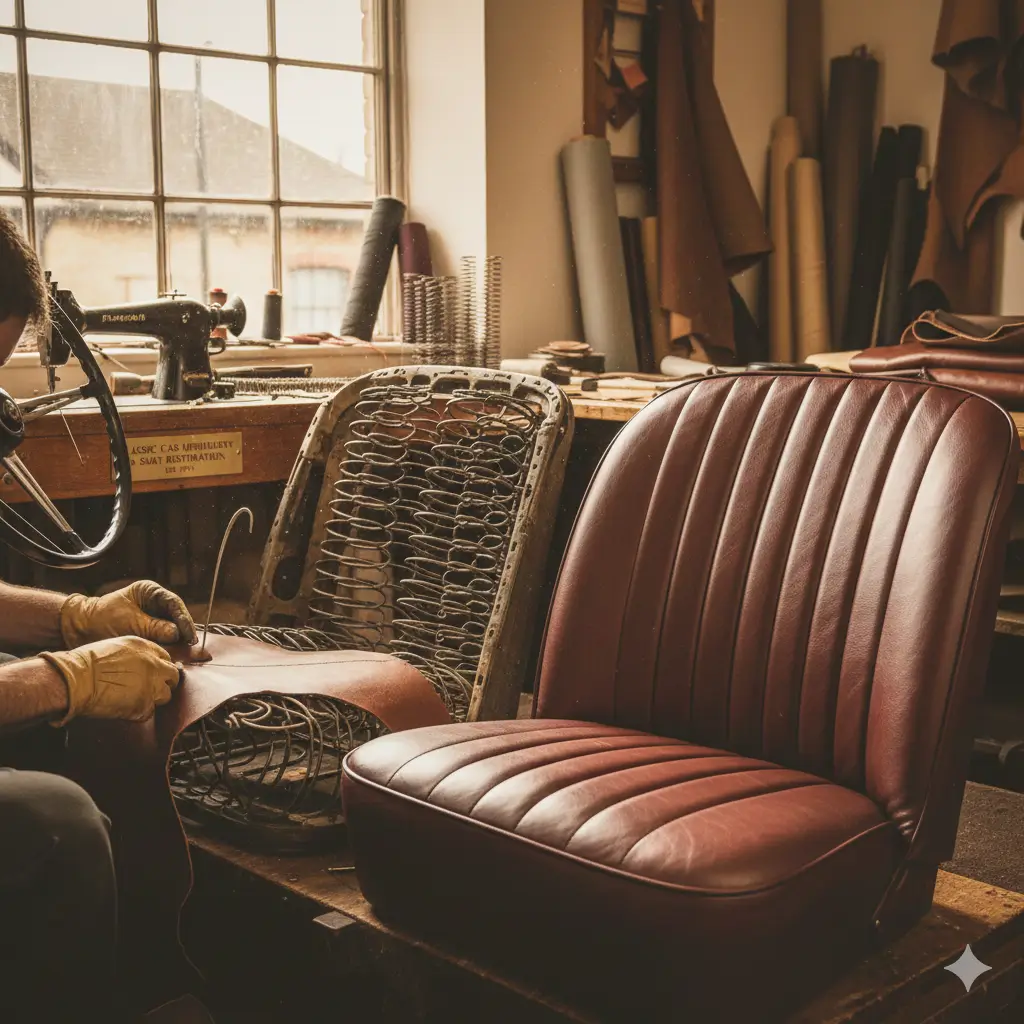
Readily available reproduction covers may be fitted to sound seat structures within several business days.
Custom-made or factory-correct covers require more time for patterning, cutting, sewing, installation, and correction.
A proper fit requires alignment of:
- Pleats and inserts
- Piping
- Seams
- Listing channels
- Bolster contours
- Seat-back transitions
- Hardware openings
- Grain or pattern direction
The cover may need to be installed, removed, adjusted, and reinstalled before it is permanently secured.
Leather, vinyl, and cloth also behave differently. Their thickness, stretch, backing, and seam construction affect how they wrap around foam and shaped seat panels.
Rushing this stage can cause curved seams, uneven pleats, distorted piping, or excessive tension that shortens the life of the upholstery.
How Long Does Headliner Restoration Take?

A straightforward classic car headliner installation may take approximately one to three business days.
Projects involving damaged bows, a warped backing board, missing retainers, brittle trim, water leaks, or glass removal may require additional time.
A bow-style headliner may require:
- Confirming the order and position of the bows
- Repairing retainers or tack strips
- Installing bows into sewn sleeves
- Centering the material
- Applying balanced tension
- Reinstalling surrounding trim
A board-style headliner may require:
- Removing the backing panel
- Stripping deteriorated foam
- Repairing cracks or warped sections
- Applying new foam-backed material
- Trimming hardware openings
- Reinstalling the panel
The schedule may also depend on whether windshield or rear-window removal must be coordinated with a glass specialist.
For more information, read Bow-Style vs. Board-Style Headliners: How to Restore Classic Car Roof Liners.
How Long Do Upholstered Door and Quarter Panels Take?
Recovering or rebuilding upholstered door and quarter panels may take approximately one to three weeks, depending on their construction and condition.
The process is faster when sound original boards or complete reproduction panels are available. More time may be needed to:
- Fabricate replacement backing boards
- Reproduce stitched details
- Match seat inserts
- Transfer moldings and emblems
- Restore armrests
- Repair warped or water-damaged panels
- Recreate missing clip locations
Panels should generally be test-fitted before the final material and trim are permanently secured. Changes in board thickness, padding, clips, or edge wrapping can affect how the panel sits against the door.
How Long Does a Complete Upholstery Package Take?
A complete classic car upholstery package commonly requires approximately four to eight weeks of active shop time when materials are available and extensive custom fabrication is not required.
An upholstery-focused package may include:
- Front and rear seats
- Foam and traditional padding
- Springs and support components
- Upholstered door and quarter panels
- Headliner and sail panels
- Armrests
- Windlace
- Piping and related soft trim
Factory-correct projects may take longer because the shop must research trim specifications, source period-appropriate materials, document original patterns, and reproduce precise construction details.
Custom restomod upholstery can also extend the timeline because one-off seats, panels, consoles, stitching layouts, and material combinations must be designed and test-fitted.
Carpet, dashboard restoration, electrical work, gauges, audio systems, and complete cabin refinishing may be scheduled separately under a broader Classic Car Interior Restoration scope.
What Can Delay Classic Car Upholstery Restoration?
The most common delays involve materials, hidden damage, missing parts, and changes in project scope.
Material availability
Period-correct cloth, vinyl grain, leather color, reproduction covers, or molded foam may require special ordering or manufacturing.
Hidden damage
Collapsed cushions may conceal broken springs, cracked frames, damaged tracks, rust, or previous improvised repairs.
Missing components
Missing bows, brackets, listing wires, trim, clips, emblems, or panel hardware may need to be sourced or fabricated.
Previous modifications
Incorrect upholstery, excessive padding, altered seat frames, speaker openings, and custom panels may need to be corrected before accurate restoration can begin.
Scope changes
Changing the color, material, stitching, or panel design after fabrication starts can require new materials and additional labor.
Outside services
Glass removal, welding, rust repair, painting, or electrical work may affect when upholstered components can be installed.
A realistic schedule should allow for inspection and correction rather than assuming every hidden component can be reused.
Hidden damage, material selection, and fabrication requirements can also influence how much classic car upholstery restoration costs.
How Can an Owner Help Keep the Project on Schedule?
Important decisions should be made before the vehicle enters active production.
Owners can help prevent avoidable delays by:
- Defining whether the goal is driver-quality, preservation, factory-correct, or custom
- Approving material samples and colors early
- Confirming that covers, foam, and trim are available
- Providing trim codes, build sheets, or reference photographs
- Identifying missing hardware before work begins
- Deciding which original materials should be preserved
- Approving a process for hidden damage and additional work
- Avoiding design changes after cutting and sewing begin
The written scope should distinguish active working time from material lead time, booking time, and outside services.
What Should You Ask About the Timeline?
Before authorizing the project, ask:
- When is the scheduled start date?
- Are the required materials already available?
- Does the estimate describe active work or total calendar time?
- What hidden damage could extend the schedule?
- Are structural seat repairs completed in-house?
- Does the project require glass or another outside specialist?
- How will additional work be approved?
- Does the timeline include test fitting and corrections?
The shortest estimate is not always the most reliable. A credible schedule should account for inspection, material availability, repair work, fitting, and final quality control.
Frequently Asked Questions
Can classic car seats be restored without leaving the entire vehicle at the shop?
In some cases, loose seats can be removed and restored separately. However, the vehicle may still be needed for final alignment, seat-track operation, hardware clearance, color comparison, and confirmation that the completed upholstery fits correctly within the cabin.
Should upholstery materials be ordered before the vehicle is dropped off?
Whenever possible, yes. Confirming the availability of covers, foam, cloth, vinyl, leather, trim, and hardware before active production can reduce avoidable downtime.
Rare or period-correct materials may require extended manufacturing or shipping lead times.
Does reusing original seat covers shorten the restoration timeline?
Not necessarily. Original covers may require careful removal, cleaning, reinforcement, seam repair, and documentation.
If the material is brittle or damaged, preserving it may take longer than installing an available reproduction cover, although it can be important for originality.
After restoration, proper care can help protect classic car upholstery from sun damage and reduce premature fading, drying, and cracking.
Can classic car upholstery restoration be completed in stages?
Yes. Seats, headliners, and upholstered panels may sometimes be restored in separate phases. The stages should be planned together so materials, colors, stitching, padding, and trim remain consistent.
Repeated removal and reinstallation can add labor when the phases are not coordinated.
Classic Car Upholstery Timelines in Huntington Beach
Coastline Classic Car Restorations evaluates classic, vintage, collector, and restored vehicle upholstery in Huntington Beach and throughout Orange County.
Our planning process may include:
- Defining the upholstery scope
- Inspecting seats and related soft trim
- Confirming material and parts availability
- Documenting original patterns and attachments
- Evaluating frames, springs, foam, and padding
- Completing final fitting and quality inspection
Because every vehicle has a different construction, condition, and restoration goal, an accurate timeline must be based on the actual upholstery work required—not a universal turnaround promise.
Learn more about our Classic Car Upholstery Restoration services in Huntington Beach for seats, foam, padding, upholstered panels, headliners, and period-correct soft-trim restoration.