

Classic car cooling-system restoration typically costs $150 to $4,000+, depending on the problem, vehicle, parts availability, labor, and whether the system needs a targeted repair or complete restoration.
Broad planning ranges include:
Minor repair or service: $150–$500
Major component repair or replacement: $500–$1,500
Full cooling-system restoration: $1,500–$4,000+
These are estimates—not fixed quotes. A rare radiator, severe corrosion, custom fabrication, engine modifications, or multiple failed components can raise the final cost.
The most reliable estimate begins with an inspection that identifies whether the problem involves airflow, coolant circulation, radiator heat transfer, system pressure, engine operation, or several combined conditions.
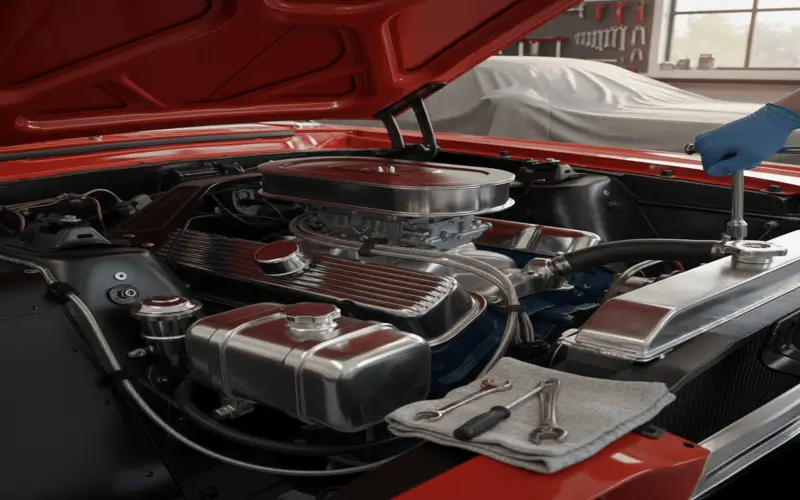
Classic Car Cooling-System Cost Breakdown
| Service | Broad planning range | What can affect the cost |
|---|---|---|
| Cooling-system diagnosis or pressure test | $75–$200 | Testing time, hidden leaks and symptom complexity |
| Professional coolant flush | $150–$350 | Capacity, contamination and repeated flushing |
| Thermostat service | $100–$300 | Housing access, corrosion and coolant replacement |
| Hoses, clamps and connections | $100–$300 | Hose availability, routing and accessibility |
| Water-pump replacement | $150–$500+ | Pump access, pulley removal and parts availability |
| Fan-clutch replacement | $150–$500 | Fan removal, part availability and shroud access |
| Radiator re-core | $400–$1,200+ | Size, core design, tank condition and originality |
| Aftermarket radiator | $300–$900+ for the radiator | Fitment, fabrication, fan and shroud modifications |
| Full cooling-system restoration | $1,500–$4,000+ | Number of components, testing, fabrication and upgrades |
The ranges above are for estimate. Parts and labor vary substantially among makes, models, engines, and restoration goals.
A written estimate should clarify whether coolant, testing, fabrication, and additional parts are included.
What Affects Cooling-System Restoration Cost?
Vehicle and Engine
Parts for common American classics may be easier to source than components for rare vehicles, imports, limited-production models, or modified engines.
Cost may increase because of:
- Rare or discontinued parts
- Unusual radiator dimensions
- Limited engine-bay access
- Custom hose routing
- Non-original engine swaps
- Previous modifications
- Component Condition
A cooling system with one leaking hose will generally cost less than a vehicle with a restricted radiator, corroded water pump, damaged heater core, and pressure loss.
Internal rust and sediment may not be visible until components are removed or tested.
Originality Requirements
Factory-correct restoration can require:
- Re-coring original radiator tanks
- Rebuilding original components
- Preserving factory mounting points
- Sourcing period-correct clamps and hoses
- Restoring the mechanical fan and shroud
- Matching original finishes
This specialized work may cost more than installing readily available replacement parts.
Labor and Accessibility
Cooling-system labor depends on how much must be removed to reach the failed component.
Corroded fasteners, crowded engine compartments, seized fittings, custom accessories, and previous incorrect installations can increase labor time.
Engine Modifications
Changes to horsepower, compression, air conditioning, transmission cooling, or vehicle use may increase cooling requirements.
A modified vehicle may need additional capacity, airflow improvements, electrical work, or custom fabrication rather than a direct factory-style replacement.
Radiator Repair, Re-Core, Replacement, or Upgrade Cost
The radiator is often one of the largest cooling-system expenses.
Repair
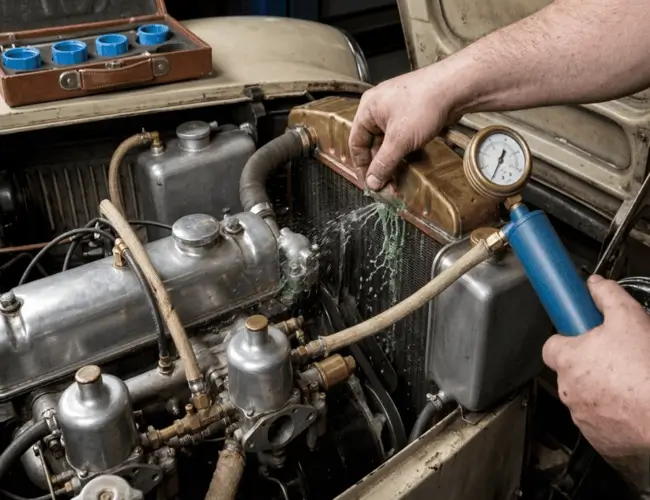
Localized radiator leaks, damaged necks, seams, or mounting points may be repairable when the radiator remains structurally sound.
The cost depends on:
- Leak location
- Tank and core condition
- Required disassembly
- Material and construction
- Pressure-testing requirements
- Re-Core
Re-coring preserves the original tanks and brackets while replacing the heat-transfer core. Planning costs commonly range from $400 to $1,200+.
Costs rise with:
- Larger radiators
- Custom core dimensions
- High-efficiency core designs
- Tank or bracket repair
- Period-correct restoration work
- Shipping to a qualified radiator specialist
- Replacement or Upgrade
An aftermarket radiator may cost approximately $300 to $900+ before installation, but the final price can increase if the vehicle requires:
- Custom mounting
- Modified hose connections
- Fan or shroud changes
- Transmission-cooler fittings
- Overflow or recovery-system changes
- Electrical work for electric fans
A radiator upgrade should be selected only when radiator condition or capacity is the confirmed limitation. See Radiator Upgrades for Classic Cars for the component-selection factors.
Water-Pump, Thermostat, and Hose Costs
Water-pump replacement commonly ranges from approximately $150 to $500+, depending on component access and parts availability.
The price may increase when:
- The fan and pulley must be removed
- Fasteners are corroded
- Gasket surfaces require correction
- The correct pump is difficult to source
- Additional belts or hoses need replacement
Thermostat service and hose replacement are usually less expensive, but accessibility and corrosion can increase labor.
A lower radiator hose may also require the correct shape or internal reinforcement. A universal hose that fits physically may not be appropriate for every system.
Fan and Airflow Costs
A cooling problem may involve the fan, fan clutch, shroud, radiator seals, or missing airflow panels rather than the radiator itself.
A mechanical-fan repair may include:
- Fan-clutch replacement
- Correct fan blade
- Pulley or belt correction
- Shroud repair
- Radiator sealing
An electric-fan conversion can add the cost of:
- Fan assembly
- Shroud
- Mounting system
- Temperature sensor or controller
- Relays and fuses
- Power and ground wiring
- Charging-system upgrades, if required
The electric conversion should be priced as a complete airflow and electrical system—not only as the cost of the fan.
For conversion requirements, read Electric Fan Conversions for Classic Cars.
Hidden Costs That Can Change the Estimate
Internal Restrictions
Rust, scale, sediment, or degraded coolant may restrict the radiator, heater core, or engine passages.
Heavy contamination can require repeated flushing, component removal, professional cleaning, re-coring, or replacement.
Cooling-System Pressure Loss
A weak radiator cap, cracked hose, leaking heater core, water-pump seepage, or damaged gasket can prevent the system from maintaining its intended pressure.
Several small leaks may require more diagnostic time than one visible failure.
Previous Incorrect Repairs
Costs may increase when correcting:
- Improper hose routing
- Mismatched components
- Incorrect water pump
- Missing fan shroud
- Unsafe wiring
- Excessive sealant
- Damaged threads or sealing surfaces
- Incorrect radiator-cap pressure
Coolant Contamination
Incorrect, mixed, or heavily contaminated coolant may require repeated flushing and replacement of corroded components.
Coolant should be selected according to the engine, radiator, heater-core, gasket, and solder materials—not by color alone.
Custom Fabrication
Non-original engines, custom radiators, modified core supports, or limited fan clearance may require brackets, hose adapters, welding, wiring, or shroud fabrication.
Targeted Repair vs. Full Cooling-System Restoration
| Scope | Purpose | Cost implication |
|---|---|---|
| Targeted repair | Correct one confirmed fault | Lowest cost when no other defects are present |
| Component restoration or replacement | Restore a deteriorated radiator, pump, fan, hose, or related part | Moderate cost based on parts and accessibility |
| Full-system restoration | Correct multiple aging, restricted, damaged, or incompatible components | Highest initial cost due to broader labor, parts and validation |
A targeted repair is not automatically temporary. It can be a complete, durable solution when one confirmed component caused the problem.
A full restoration may reduce recurring failures when it addresses multiple deteriorated or incompatible components together, but the recommended scope should always depend on inspection results.
How Vehicle Goals Affect the Price
Original or Show Car
Factory-correct work may involve rebuilding original components, re-coring the radiator, preserving mounting points, and sourcing period-correct parts. Specialized labor can increase the price.
Daily Driver
A regularly driven classic may prioritize dependable low-speed airflow, serviceable parts, corrosion protection, and consistent temperature control.
Modified or Restomod Vehicle
A modified vehicle may require increased radiator capacity, an electric fan, controller, alternator evaluation, custom hoses, or fabricated mounts.
Neither factory-style restoration nor performance upgrading is automatically less expensive. The final price depends on the required components and installation work.
How to Avoid Unnecessary Cooling-System Costs
Before authorizing repairs:
- Confirm the engine’s actual temperature
- Request diagnosis before purchasing upgrades
- Ask for an itemized estimate
- Separate required repairs from optional improvements
- Ask whether pressure testing and final validation are included
- Confirm parts and workmanship warranty terms
- Preserve usable original components when practical
- Ask whether additional work requires approval
Replacing one component can solve overheating when that component is the confirmed cause. When the cause is uncertain, diagnosis helps prevent unnecessary parts replacement.
What Should a Full Cooling-System Estimate Include?
Depending on vehicle condition, an estimate may address:
- Initial inspection and temperature verification
- Pressure and leak testing
- Radiator condition
- Water-pump and thermostat condition
- Hoses, clamps, belts, and connections
- Fan, fan clutch, and shroud
- Coolant condition
- Road testing and temperature validation
Not every vehicle needs every service. The estimate should identify required work, optional upgrades, and any items that cannot be confirmed until disassembly.
Frequently Asked Questions
How much does it cost to fix a classic car cooling system?
Broad planning costs range from approximately $150 for minor service to $4,000+ for complete restoration, depending on the vehicle, components, labor, and restoration goals.
How much does a classic-car radiator re-core cost?
A re-core may cost approximately $400 to $1,200+, depending on radiator size, core design, tank condition, and specialist labor.
What is included in a full cooling-system restoration?
The scope may include radiator work, hoses, thermostat, water pump, fan system, pressure components, coolant service, compatibility corrections, testing, and final validation.
The actual work should depend on component condition.
Why do cooling-system estimates vary so much?
Classic vehicles differ in design, accessibility, parts availability, prior modifications, corrosion, originality requirements, and the number of components involved.
Can replacing the radiator fix overheating?
Yes, when radiator restriction, leakage, deterioration, or insufficient capacity is the confirmed cause. It will not correct unrelated airflow, circulation, pressure, or engine-tuning problems.
Final Answer: Classic Car Cooling-System Restoration Cost
Classic car cooling-system repair or restoration typically ranges from $150 to $4,000+.
Minor repairs fall toward the lower end, while radiator work, water-pump replacement, custom fabrication, multiple failures, or complete system restoration can increase the total substantially.
At Coastline Classic Car Restorations in Huntington Beach, estimates are based on the vehicle’s condition, component compatibility, originality goals, parts availability, and inspection findings.
For professional diagnosis, repair, or complete system restoration, explore our classic car cooling-system restoration services.