

Classic cars commonly overheat in traffic because airflow through the radiator decreases at low speeds while the engine continues producing heat.
When the vehicle is moving, outside air naturally passes through the grille and radiator.
At a stop, that natural airflow disappears, and the cooling fan must pull enough air through the radiator to remove engine heat.
If the fan, shroud, radiator, coolant circulation, or engine tune is slightly inefficient, the temperature may rise at stoplights but return to normal once the car begins moving.
This pattern usually indicates a low-speed cooling imbalance, not necessarily complete cooling-system failure.
To understand the complete coolant and airflow cycle, read How Classic Car Cooling Systems Work..
Why Does a Classic Car Overheat at Idle but Not While Driving?
A classic car may overheat at idle but stay cool on the highway because the radiator receives significantly more airflow when the vehicle is moving.
At highway speed:
- Outside air is forced through the radiator
- Heat is removed from the coolant more efficiently
- Fan and water-pump speeds are generally higher
- Hot air moves through and out of the engine compartment
At idle:
- Natural airflow is minimal
- The fan must provide most of the radiator airflow
- Fan and water-pump speeds decrease
- Heat accumulates under the hood
- Existing cooling-system weaknesses become more noticeable
If the temperature drops after the vehicle begins moving, insufficient low-speed airflow is a likely contributor. However, airflow is not the only possible cause.
Is It Normal for a Classic Car to Overheat in Traffic?
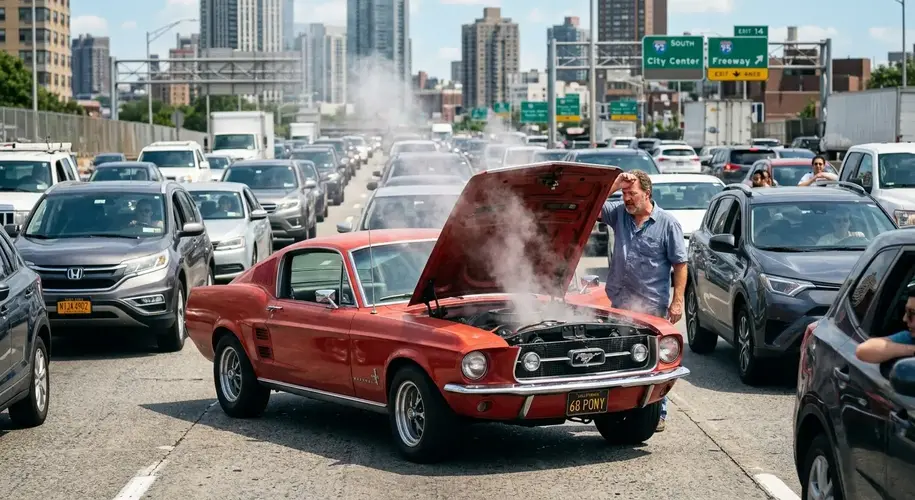
No. Traffic overheating is common among older vehicles, but it should not be considered normal.
A properly restored and correctly configured cooling system should maintain a safe operating temperature during ordinary street driving and reasonable periods of idling.
Some temperature movement may be expected depending on the vehicle, engine configuration, thermostat, ambient temperature, gauge accuracy, and driving conditions.
However, a temperature that continues climbing, reaches the warning zone, pushes out coolant, or produces steam indicates a problem that requires attention.
Low-Speed Airflow Problems
The radiator can release heat only when enough air passes through its core. While the vehicle is moving, forward motion provides much of this airflow.
In traffic, the fan, shroud, radiator seals, and factory airflow panels must work together.
Weak Fan Performance
A correctly configured mechanical fan can provide adequate idle cooling. Problems develop when the fan system no longer performs as intended.
Possible causes include:
- Worn thermal fan clutch
- Incorrect fan diameter or blade design
- Improper fan positioning
- Incorrect pulley ratio
- Fan installed backward
- Excessive distance between the fan and radiator
A worn fan clutch may continue spinning but fail to engage strongly when hot. As a result, the fan may move too little air at idle even though it appears functional.
An electric fan may improve low-speed airflow in the correct application, but it will not correct every overheating problem. For a fan-specific comparison, read Electric Fan Conversions for Classic Cars.
Missing or Inefficient Fan Shroud
A fan shroud helps the fan draw air through a larger portion of the radiator.
Without a properly fitted shroud, the fan may pull air only through the area directly in front of its blades. Much of the radiator core may receive limited airflow while the vehicle is stationary.
Shroud performance may also be reduced by:
- Large gaps around its edges
- Incorrect fan depth
- Poor fan alignment
- Damage or missing sections
- Mismatched aftermarket components
Even a strong fan may provide inadequate cooling if the shroud cannot direct airflow through the radiator effectively.
Air Bypassing the Radiator
Air follows the path of least resistance. If large openings exist around the radiator, incoming air may travel around the core instead of through it.
Missing components can contribute to this problem, including:
- Upper radiator seals
- Side baffles
- Lower air dams
- Core-support panels
- Grille-to-radiator ducting
These parts may appear minor, but they help control how air travels through the radiator and engine compartment.
Radiator Heat-Transfer Limitations
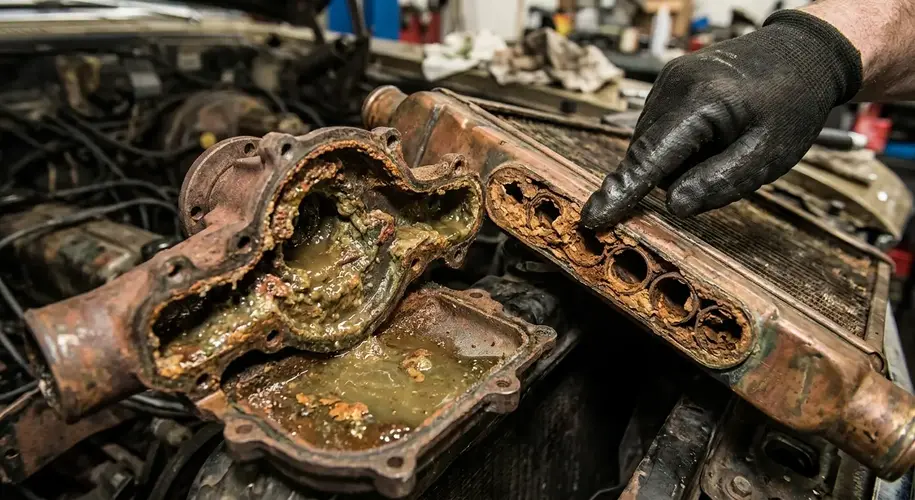
A radiator may look clean externally while being restricted or deteriorated internally.
Rust, scale, sediment, and degraded coolant can block individual tubes, reducing the radiator’s effective heat-transfer area.
At highway speed, increased airflow may partially compensate for this lost capacity. At idle, the radiator’s reduced efficiency becomes more noticeable.
Radiator performance may also be affected by:
- Bent, damaged, or corroded fins
- External dirt and debris
- Excessive paint on the core
- Incorrect radiator sizing
- A core design that restricts airflow
- Poor compatibility with the fan and shroud
Installing a larger radiator does not automatically solve traffic overheating.
If airflow bypasses the core or the fan cannot pull sufficient air through it, additional radiator capacity may provide little improvement.
If the radiator is confirmed as the limiting component, compare the available options in Radiator Upgrades for Classic Cars.
Coolant-Flow and Temperature-Control Problems
Although traffic overheating frequently points to airflow, coolant must also circulate properly through the engine and radiator.
Reduced Coolant Circulation
Most classic-car water pumps are driven by the engine, so pump speed decreases at idle. A healthy system should still circulate enough coolant, but restrictions or incorrect components can reduce flow.
Possible contributors include:
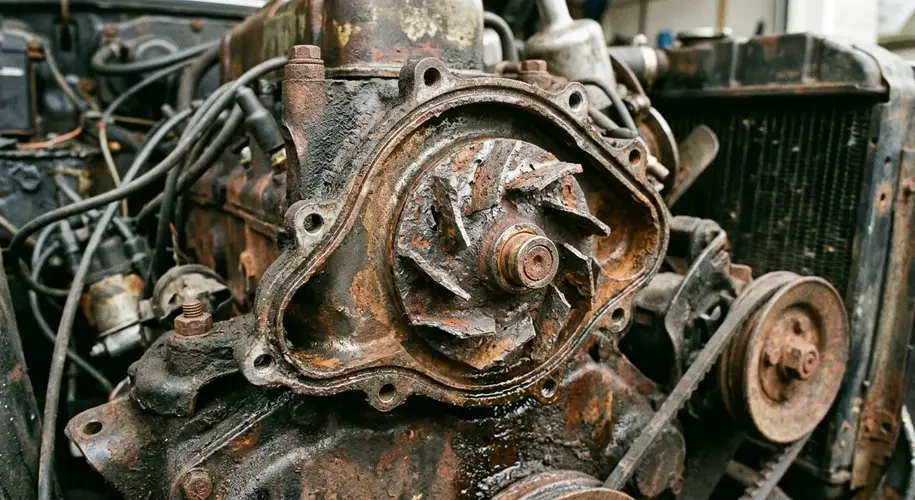
- Worn or corroded water-pump impeller
- Incorrect replacement water pump
- Loose or slipping belt
- Improper pulley ratio
- Restricted engine passages
- Internally deteriorated hoses
- Incorrect coolant routing
Reduced circulation and weak airflow can occur together, causing the engine temperature to rise faster in traffic.
Thermostat Problems
The thermostat regulates coolant flow and helps maintain a stable operating temperature.
Overheating may result from:
- A thermostat that does not open fully
- Inconsistent operation
- An incorrect temperature rating
- Improper installation
- A thermostat that does not match the engine
Removing the thermostat is not a reliable general solution. The cooling system was designed to operate within a controlled temperature range.
Trapped Air
Air pockets can interfere with coolant circulation and reduce coolant contact with internal engine surfaces.
They may develop after:
- Coolant service
- Hose or radiator replacement
- Engine rebuilding
- Improper system filling
- A recurring coolant leak
Trapped air can create localized hot spots, unstable temperatures, or inconsistent gauge readings.
Cooling-System Pressure Loss
System pressure raises the coolant’s boiling point. If the cooling system cannot maintain its intended pressure, coolant may boil or escape sooner.
Pressure may be lost through:
- An incorrect or weak radiator cap
- Cracked hoses
- Loose clamps
- Radiator leaks
- Water-pump seepage
- Heater-core leaks
- Deteriorated seals or gaskets
A pressure problem may also cause coolant odor, overflow, or puddles after shutdown.
The correct radiator-cap pressure depends on the specific vehicle and radiator design.
Installing a higher-pressure cap without confirming compatibility may damage older radiators, heater cores, hoses, or soldered joints.
Engine Conditions That Increase Heat
Not every traffic-overheating problem begins in the cooling system. Engine conditions can produce more heat than the system can remove at idle.
Possible causes include:
- Retarded ignition timing
- Excessively lean air-fuel mixture
- Vacuum leaks
- Incorrect carburetor calibration
- Excessive engine load
- Increased compression or horsepower
A modified engine may also generate more heat than the original radiator and fan system were designed to manage.
Additional thermal load may come from:
- Performance engine modifications
- Air conditioning
- Automatic-transmission heat
- Superchargers or turbochargers
- Heavy vehicle loads
In these cases, the cooling system may be functional but no longer have sufficient reserve capacity for modern traffic conditions.
Engine Bay Heat Soak
During slow driving or prolonged idling, hot air can become trapped under the hood. This is known as heat soak.
Heat soak can:
- Raise the temperature of air entering the radiator
- Reduce heat-transfer efficiency
- Increase carburetor and fuel-line temperatures
- Contribute to vapor lock
- Cause temperatures to remain elevated after shutdown
Headers, restricted hood ventilation, and crowded engine compartments can make heat soak more severe.
A vehicle that overheats at idle but cools after it begins moving commonly has a low-speed airflow limitation.
However, coolant circulation, radiator efficiency, system pressure, and engine operation may also contribute.
For a symptom-based testing sequence, read How to Fix Classic Car Overheating in Traffic?
Why Replacing One Part May Not Fix the Problem
Classic-car overheating is frequently caused by several small inefficiencies working together.
A vehicle might have a partially restricted radiator, weak fan clutch, missing radiator seals, and slightly incorrect ignition timing.
No single issue may cause severe overheating alone, but together they can exceed the system’s cooling capacity during prolonged idling.
This explains why some classic cars continue running hot after receiving a new radiator, water pump, thermostat, or electric fan. One weakness was corrected, but other airflow, circulation, pressure, or tuning problems remain.
Frequently Asked Questions
Why does my classic car overheat at stoplights?
At stoplights, natural airflow through the radiator decreases. The cooling system becomes more dependent on fan performance, shrouding, radiator efficiency, and coolant circulation.
Why does the temperature drop when I start driving?
Vehicle movement forces more air through the radiator, allowing it to remove heat more efficiently. This commonly indicates insufficient low-speed airflow.
Can a bad fan clutch cause overheating only in traffic?
Yes. A worn thermal fan clutch may fail to provide sufficient airflow at idle even though the fan still appears to spin.
Can traffic overheating damage the engine?
Yes. Continued overheating can damage head gaskets, cylinder heads, bearings, pistons, seals, and other internal components. Learn more in What Happens If a Classic Car Overheats.
Final Answer: Why Classic Cars Overheat in Traffic
A car that stays cool on the highway but overheats while stationary usually has a low-speed cooling imbalance. The actual limiting factor should be identified before components are replaced or upgraded.
At Coastline Classic Car Restorations in Huntington Beach, we evaluate airflow, coolant circulation, radiator efficiency, system pressure, component compatibility, and engine operation as a complete system.
If your classic car overheats in Huntington Beach or Orange County traffic, learn more about our classic car cooling-system restoration service and schedule an evaluation to identify the root cause.