

A classic car radio may have static or no sound because of a failed speaker, damaged wiring, a poor ground, an antenna problem, electrical interference, incompatible components, or an internal radio fault.
If the radio lights up but produces no sound, power may be reaching the unit while the audio signal is failing somewhere between the radio and speakers.
Diagnose the complete audio path before replacing the original radio.
What Does Each Radio Symptom Usually Mean?
| Symptom | Common areas to inspect |
|---|---|
| Radio powers on but has no sound | Speaker, speaker wiring, ground, connector, radio output |
| Only one speaker works | Failed speaker, loose wire, balance control, connector |
| Static starts when the engine runs | Ground, ignition interference, alternator noise, wire routing |
| Static occurs only on AM or FM | Antenna, antenna ground, cable, tuner, reception |
| Volume knob crackles when turned | Dirty or worn control |
| Sound cuts out over bumps | Loose connector, damaged wiring, weak ground, internal connection |
| Sound is weak or distorted | Speaker damage, low voltage, incorrect impedance, radio fault |
| Radio fuse repeatedly blows | Short circuit, damaged power wire, wrong fuse, internal failure |
These symptoms identify likely inspection areas, not a final diagnosis. Different faults can produce similar results.
Why Does a Classic Car Radio Have Power but No Sound?
When a radio has power but no sound, the power circuit may be working while the output signal is not reaching the speakers.
Possible causes include:
- A failed or disconnected speaker
- Broken speaker wiring
- A loose or corroded connector
- A weak radio ground
- A dirty or worn volume control
- Incorrect previous wiring
- Incompatible speaker impedance
- A failed radio-output component
Diagnosis should confirm that the radio receives stable power, has a proper ground, and produces an output signal.
The speaker circuit should then be checked for an open wire, short, failed speaker, or incorrect connection.
This process prevents replacing an original radio when the actual problem is a speaker, wire, connector, or ground.
Can a Damaged Speaker Cause Static, Distortion, or No Sound?
Yes. A failed or incorrectly matched speaker can make a working radio appear defective.
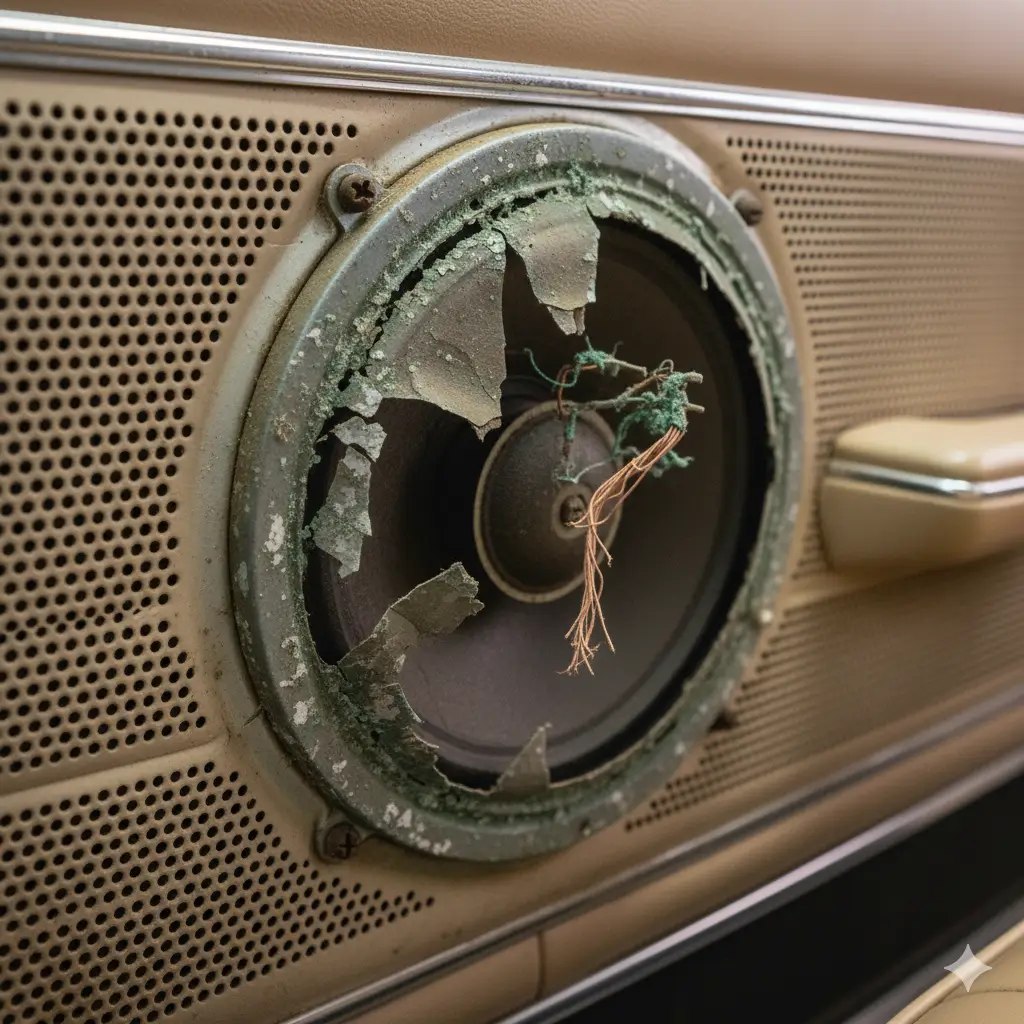
Original classic car speakers commonly use paper cones and aging surround materials that can crack, separate, or deteriorate.
Terminals and voice-coil leads can also corrode or break.
Speaker-related symptoms include:
- No sound from one speaker
- Buzzing or rattling
- Distortion as volume increases
- Thin or weak sound
- Intermittent output
- One speaker playing louder than another
Speaker inspection may include checking the cone and surround, inspecting terminals, testing the circuit for an open or short, confirming polarity, and verifying the speaker’s rated impedance.
An original speaker may sometimes be repaired or reconed.
A compatible replacement can also be installed behind the factory grille when its dimensions, impedance, mounting depth, and power requirements match the system.
How Do Old Wiring and Previous Modifications Affect the Radio?
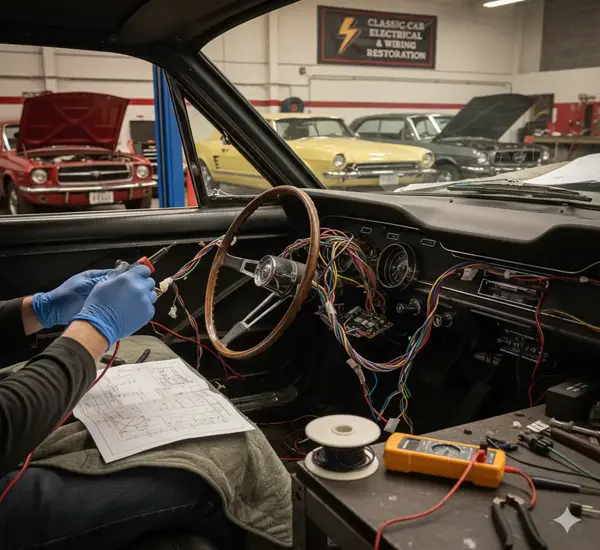
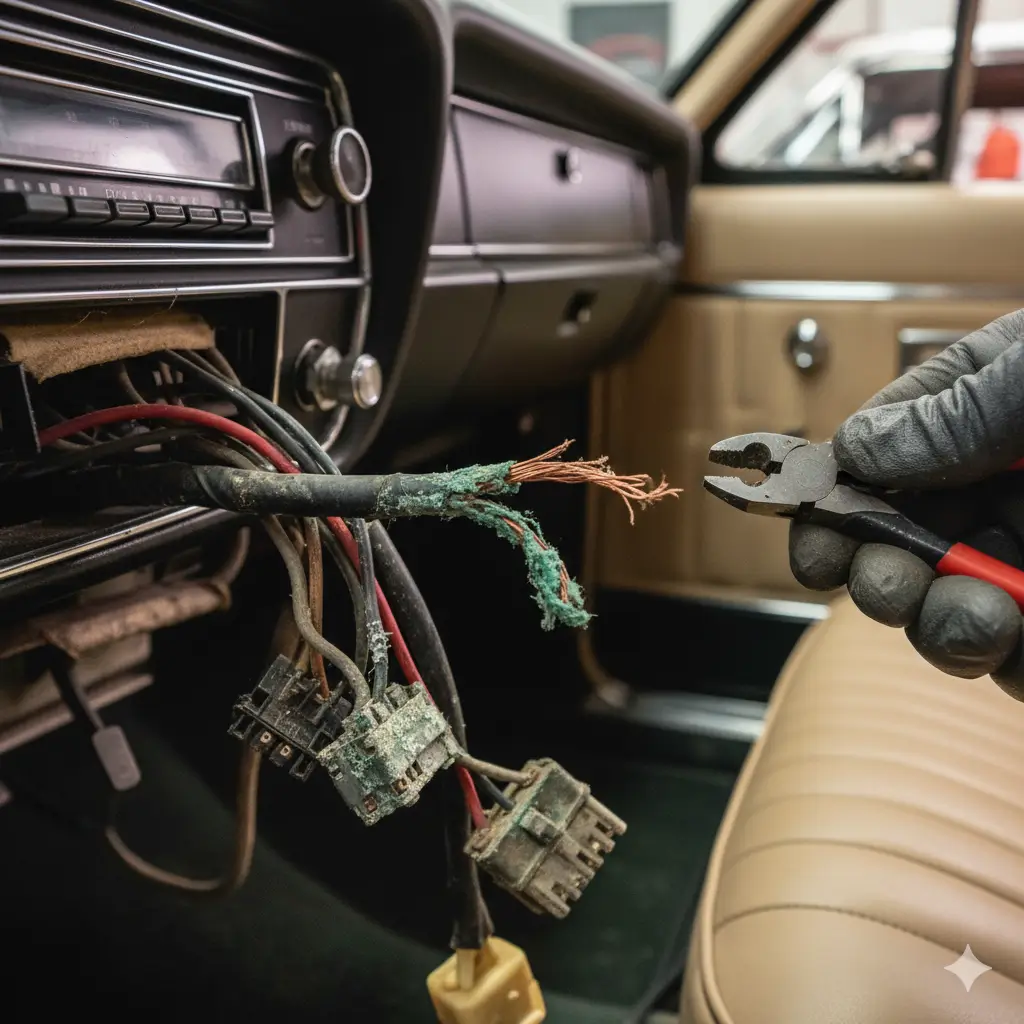
Old or modified wiring can cause intermittent sound, static, blown fuses, low voltage, or complete radio failure.
Common problems include:
- Brittle or cracked insulation
- Loose speaker wires
- Corroded terminals
- Poor crimp or taped connections
- Cut factory connectors
- Pinched power wires
- Incorrect wire routing
- Shared accessory grounds
If sound disappears over bumps or returns when the dashboard moves, inspect for a loose connection or damaged wire.
If the problem began after dashboard removal, interior restoration, repainting, or accessory installation, check the areas disturbed during that work.
Damaged wiring should be corrected before another radio, amplifier, or speaker is installed.
Connecting modern equipment to an unreliable circuit can conceal the original problem or cause additional damage.
What Are the Symptoms of a Bad Radio Ground?
A poor ground can cause static, whining, popping, weak output, intermittent sound, or complete radio failure.
Ground-related symptoms may include:
- Noise that changes with engine speed
- Interference when lights, fans, or wipers operate
- Sound cutting in and out
- Popping when accessories are switched on
- Radio operation changing when the dashboard or nearby trim moves
Corrosion, paint, body repairs, loose hardware, or previous electrical work can interrupt the ground path.
A newly painted dashboard or body panel may also prevent proper contact if the grounding point was not prepared correctly.
Inspect the radio ground and related body-ground connections before concluding that the radio has failed.
Why Does the Radio Have Static When the Engine Is Running?
Static or whining that begins only after the engine starts usually indicates electrical interference rather than a failed speaker.
Possible sources include:
- Ignition-system interference
- Alternator or charging-system noise
- Weak radio or antenna grounds
- Poor wire routing
- Damaged shielding
- Electric fans or other accessories
- Multiple components sharing an unsuitable ground
If the pitch rises and falls with engine speed, the charging system, ignition system, grounding, shielding, and wire routing should be inspected.
A radio that sounds clear with the engine off but becomes noisy when the engine runs provides an important diagnostic clue: the problem is likely being introduced by an operating electrical component.
Can the Antenna Cause Radio Static?
Yes. If static occurs only while listening to AM or FM, the antenna, antenna ground, cable, connection, or tuner may be responsible.
Common antenna problems include:
- A loose cable behind the radio
- A damaged coaxial cable
- A broken or corroded mast
- A weak antenna ground
- Corrosion at the antenna base
- An incompatible aftermarket antenna
- Poor tuner performance
If Bluetooth or AUX audio sounds clear but radio stations do not, the speakers and radio-output path may be functioning correctly.
If you’re considering adding modern connectivity to your vehicle, read our guide on how to add Bluetooth to a classic car without cutting the dash.
The fault is more likely related to reception, the antenna system, or the tuner.
If every source has static, the problem is less likely to be limited to the antenna.
What Should You Do if the Radio Fuse Keeps Blowing?
Stop replacing the fuse until the cause has been identified. A repeatedly blown fuse may indicate a short circuit, damaged power wire, incorrect fuse rating, improperly connected accessory, or internal radio failure.
Never install a higher-amperage fuse to prevent it from blowing.
An oversized fuse can allow damaged wiring or components to overheat and create a fire risk.
Inspect the circuit for pinched wires, damaged insulation, incorrect connections, shorted components, and the manufacturer-specified fuse rating before restoring power.
Can a 6-Volt or Positive-Ground System Cause Radio Problems?
Yes. Audio components must be compatible with the vehicle’s actual voltage and grounding configuration.
Some classics originally used 6-volt or positive-ground electrical systems. Others have been converted to 12 volts or negative ground.
A converted vehicle may contain a mixture of original and modern wiring.
Before installing or testing equipment, confirm:
- System voltage
- Ground polarity
- Radio requirements
- Voltage-converter compatibility
- Speaker impedance
- Amplifier and accessory requirements
Incorrect voltage or polarity can cause poor operation or equipment damage. Do not assume the electrical system is original based only on the vehicle’s year.
When Is the Original Radio Probably at Fault?
The radio itself becomes a stronger suspect after its power, ground, speakers, wiring, antenna, and electrical compatibility have been checked.
Possible signs of internal failure include:
- Power with no output signal
- Static from every speaker and audio source
- Very weak output
- Crackling when controls move
- Intermittent operation after external connections are verified
- Loss of tuning or reception
- Overheating or a burning odor
Internal service may involve control cleaning, capacitor or output-component replacement, tuner repair, solder-joint inspection, and bench testing.
If the radio overheats, smokes, or produces a burning odor, turn it off and disconnect power safely.
Do not continue operating it until the radio and circuit have been inspected.
For an original or period-correct unit, review classic car radio restoration vs. replacement before installing another radio.
What Can the Owner Check Safely?
You can document useful symptoms without removing the dashboard or opening the radio.
Note whether:
- The problem affects one speaker or every speaker
- Static occurs with the engine off
- Noise changes with engine speed
- Static affects radio reception only
- The volume control crackles when moved
- Sound cuts out over bumps
- The fuse repeatedly blows
- Lights, fans, or wipers change the sound
Also note whether the problem began after battery replacement, repainting, dashboard removal, engine repair, alternator replacement, or stereo work.
Avoid opening the radio, bypassing fuses, probing brittle wiring, or changing the fuse rating without the correct tools and experience.
Classic Car Radio Diagnosis in Huntington Beach
Coastline Classic Car Restorations having 14 years of experience diagnoses static, no-sound conditions, weak output, speaker problems, wiring faults, grounding issues, antenna problems, and original-radio failures in Huntington Beach.
An evaluation may include the radio’s power and output, speaker condition and impedance, audio wiring, grounds, antenna operation, vehicle voltage and polarity, and previous aftermarket modifications.
Once the fault is identified, the appropriate solution may involve speaker repair, wiring correction, improved grounding, radio restoration, or a compatible replacement.
Learn more about our specialized classic car audio restoration solutions.
Call (657) 540-8792 or request a classic car audio inspection in Huntington Beach.
Frequently Asked Questions
Why does my classic car radio have power but no sound?
The radio may have a failed speaker, broken speaker wire, poor ground, loose connector, incompatible speaker, or internal output fault.
Why does the static get louder when I accelerate?
Noise that changes with engine speed often points to ignition interference, alternator noise, weak grounding, damaged shielding, or poor wire routing.
Can a bad speaker make the radio seem broken?
Yes. A failed, disconnected, or incompatible speaker can cause no sound, distortion, weak output, or intermittent audio even when the radio works.
Is it safe to keep replacing a blown radio fuse?
No. Repeated fuse failure may indicate a short, damaged wiring, an incorrect connection, or internal component failure. Diagnose the cause and use only the specified fuse rating.