

Restore your classic car’s original radio when it is complete, repairable, and important to the vehicle’s authenticity.
Convert it when you want modern features while retaining the factory appearance.
Replace it when the original radio is missing, incorrect, severely damaged, or unsuitable for how you use the car.
For a vehicle with an uncut dashboard, restoration or another reversible solution is usually the best starting point.
The final decision should consider the radio’s condition, dashboard opening, electrical system, desired features, and the vehicle’s intended use.
Should You Restore, Convert, or Replace Your Classic Car Radio?
| Your situation | Recommended option | Why |
|---|---|---|
| Original radio is complete and correct | Restore it | Preserves the factory unit and period-correct operation |
| You want Bluetooth without changing the dashboard | Convert it or add hidden Bluetooth | Provides modern function with minimal visible change |
| Original radio is missing or beyond practical repair | Install a compatible replacement | Restores audio without rebuilding an unusable unit |
| Vehicle is collector-grade or factory-correct | Prioritize restoration | Protects originality and model-specific components |
| Vehicle is a restomod or regular driver | Consider conversion or replacement | Modern usability may be more important |
| Dashboard was previously modified | Evaluate replacement or dashboard repair | The best option depends on your restoration goals |
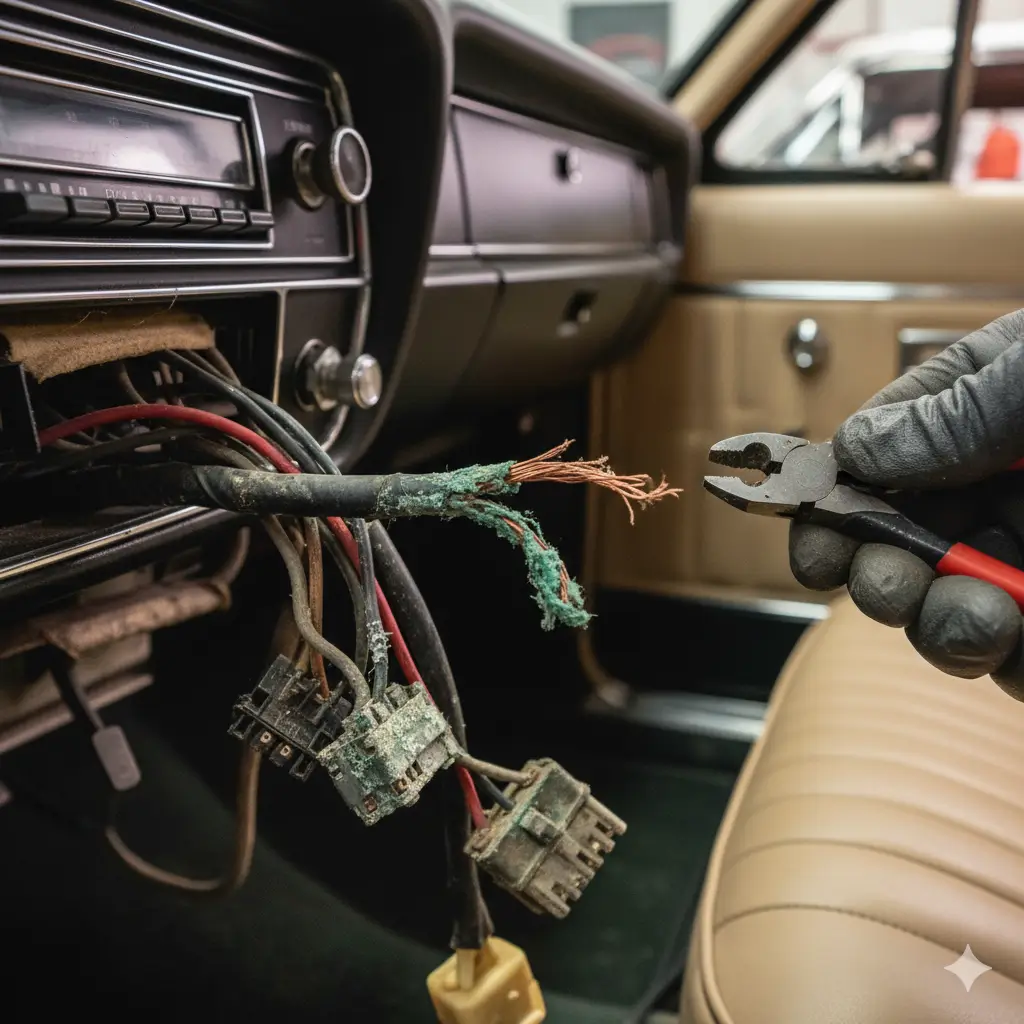
Do not make the decision based only on whether the radio turns on. Damaged speakers, wiring, grounds, antennas, or previous modifications can make a functional radio appear defective.
What Is the Difference Between Repair, Restoration, Conversion, and Replacement?
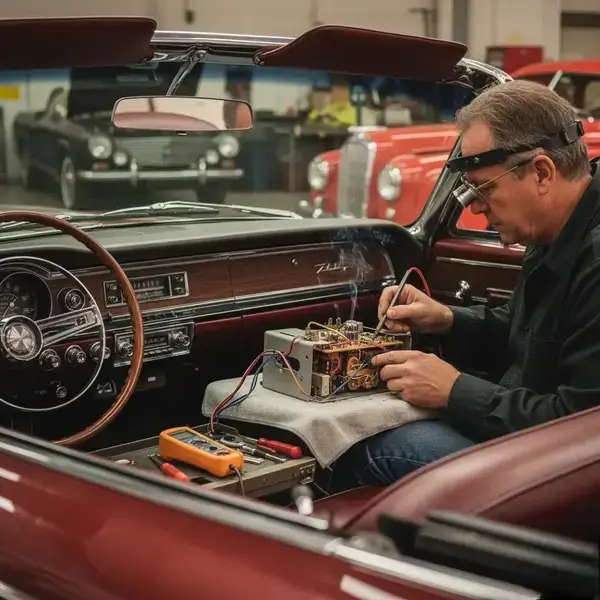
Repair corrects a specific fault. Restoration rebuilds and tests the original radio more completely. Conversion retains the factory exterior while adding modern operation. Replacement installs a different radio or audio source.
| Option | Primary purpose | Main tradeoff |
|---|---|---|
| Repair | Correct a defined problem | Does not modernize the system |
| Restoration | Preserve the original radio and its operation | Modern features may remain limited |
| Conversion | Keep the factory appearance while adding modern functions | Reduces internal originality |
| Replacement | Replace a missing, incorrect, or impractical radio | Does not retain the original operating unit |
A repair may be part of a restoration, but the terms are not interchangeable. Repair targets a failure. Restoration considers the radio’s overall electronics, controls, appearance, operation, and testing.
When Should You Restore the Original Radio?
Restore the radio when it is correct for the vehicle, reasonably complete, and worth preserving.
Restoration is usually appropriate when:
- The factory or period-correct radio is still present
- The face, dial, knobs, push buttons, and case are complete
- The dashboard opening and surrounding trim remain uncut
- The vehicle is being returned to factory-correct condition
- The radio, bezel, or mounting arrangement is rare or model-specific
- Original operation matters more than modern features
- Inspection confirms that rebuilding is practical
Restoration may involve servicing controls and the tuner, replacing failed internal components, preserving visible parts, bench testing, and confirming output before reinstallation.
It may not be practical when important parts are missing, damage or corrosion is extensive, or rebuilding does not support the vehicle’s intended use.
A concealed or properly fitted replacement system may then be more appropriate.
When Should You Convert the Original Radio?
Convert the radio when you want modern convenience without installing a visibly modern stereo.
Depending on the radio and conversion method, the original face, dial, knobs, bezel, dashboard opening, and mounting position can remain in place.
Available features may include Bluetooth, AUX input, improved tuning, stronger speaker output, or concealed controls.
Conversion is often suitable for a weekend cruiser or regularly driven classic. However, it is not the same as factory-correct restoration.
Some or all of the original internal electronics may be modified or replaced.
For a rare or concours-level vehicle, consider whether modern convenience justifies reducing the radio’s internal originality.
An independent hidden receiver may be preferable when the original radio should remain physically and electronically intact.
Learn more about adding Bluetooth to a classic car without cutting the dashboard.
When Should You Replace a Classic Car Radio?
Replace the radio when retaining the existing unit is impractical or inconsistent with the vehicle’s purpose.
Replacement may be appropriate when:
- The original radio is missing
- The installed radio is incorrect
- The case, face, controls, or internal assembly is severely damaged
- Necessary parts are unavailable
- The dashboard was already modified
- The car is being built as a restomod
- Modern controls matter more than originality
- A compatible factory-look radio can be installed without further damage
Replacement should not automatically mean cutting an intact dashboard. Consider a radio designed for the existing opening, a concealed receiver, or another reversible installation first.
If an original or period-correct radio is removed, label it and retain it with its knobs, bezel, brackets, connectors, and hardware. It may still have restoration or resale value.
Should You Replace a Radio That Has Static or No Sound?
No. Diagnose the complete audio system before replacing the radio.
Static, distortion, weak output, or no sound may result from:
- A damaged or disconnected speaker
- Broken speaker wiring
- A weak or corroded ground
- A loose connector
- Antenna or reception problems
- Electrical interference
- Dirty or worn controls
- Incorrect speaker impedance
- Internal radio failure
Diagnosis should confirm stable power, proper grounding, radio output, speaker condition, antenna operation, and wiring continuity. This helps distinguish a failed radio from a less extensive speaker, connection, or grounding problem.
For symptom-specific guidance, read why a classic car radio may have static or no sound.
What Are the Alternatives to a Visible Modern Stereo?
The primary alternatives are a factory-look radio, an original-radio conversion, or a hidden Bluetooth system.
A factory-look radio is a modern replacement designed to fit or resemble the original radio location. It may be appropriate when the original unit is missing or modern controls are a priority.
Before installation, verify the knob spacing, mounting depth, bezel fit, voltage, polarity, speaker compatibility, and wiring requirements.
A hidden Bluetooth receiver can be installed behind the dashboard, inside the glovebox, under a seat, or behind an interior panel.
It is often the better choice when wireless audio is the main goal and the dashboard should remain visually unchanged.
Neither option will correct damaged speakers, faulty wiring, weak grounds, or electrical interference. Those problems should be diagnosed before any upgrade is installed.
Can Replacing a Classic Car Radio Affect Its Value?
Yes, especially when replacement causes permanent dashboard changes or the loss of correct components.
Potential concerns include:
- Cutting or enlarging the radio opening
- Damaging model-specific bezels or trim
- Removing factory connectors
- Drilling visible mounting holes
- Discarding the original radio or hardware
- Installing wiring that cannot be reversed
The effect on value depends on the vehicle’s rarity, condition, documentation, and likely buyer. Collector-grade cars generally benefit more from original components and reversible work than custom builds do.
Replacement itself is not necessarily harmful. A properly fitted installation that protects the dashboard, preserves removed parts, and can be reversed presents less risk.
What Affects the Cost of Each Option?
Cost depends on the radio’s condition, completeness, parts availability, dashboard access, wiring condition, speaker compatibility, and requested features.
Restoration becomes more involved when a radio is rare, incomplete, corroded, or requires specialist electronic work.
Conversion costs depend on the selected features and electrical adaptations. Replacement costs increase when previous modifications must be corrected or custom mounting is required.
See our classic car audio restoration cost guide for detailed pricing factors and planning ranges.
Classic Car Radio Evaluation in Huntington Beach
Coastline Classic Car Restorations evaluates classic car radios and audio systems in Huntington Beach for owners throughout Orange County.
We inspect the radio, dashboard, speakers, audio wiring, grounds, antenna, electrical configuration, and previous modifications.
We then explain whether repair, restoration, conversion, hidden Bluetooth, or a properly fitted replacement best supports the vehicle and your goals.
Frequently Asked Questions
Is it better to restore or replace a classic car radio?
Restore it when the original unit is complete, repairable, and important to the vehicle’s authenticity. Replace it when it is missing, incorrect, severely damaged, or unsuitable for the vehicle’s intended use.
Can an original classic car radio be converted to Bluetooth?
Yes. Many original radios can be converted or paired with a concealed Bluetooth receiver while retaining the factory face, knobs, bezel, and dashboard opening.
Does a radio that powers on but has no sound need replacement?
Not necessarily. The problem may involve a speaker, wire, ground, connector, antenna, control, or internal output component. Diagnose the entire audio path first.
Can modern audio be installed without changing the dashboard?
Yes. Options include an original-radio conversion, hidden Bluetooth receiver, compatible factory-look radio, and speakers installed behind factory grilles.