

Yes. Bluetooth can be added to many classic cars without cutting the dashboard, replacing the original radio face, or visibly changing the factory interior.
The three main options are:
- Convert the original radio internally
- Install a hidden Bluetooth receiver
- Use a properly fitted factory-look Bluetooth stereo
The right option depends on whether the original radio is present, how much originality you want to preserve, the vehicle’s electrical system, and whether you want Bluetooth only or a complete audio upgrade.
Which No-Cut Bluetooth Option Is Best?
| Bluetooth option | Best for | Visible dashboard change | Original radio altered? |
|---|---|---|---|
| Original-radio conversion | Drivers wanting factory appearance with modern operation | None or minimal | Usually yes |
| Hidden Bluetooth receiver | Owners who want the original radio left intact | None | Usually no |
| Factory-look stereo | Cars with a missing, incorrect, or unusable radio | Minimal when properly fitted | Original radio is replaced |
| Visible modern stereo | Restomods prioritizing modern controls | Significant | Original radio is replaced |
A conversion usually offers the most integrated factory-style appearance. A hidden receiver may preserve more overall originality because the original radio can remain untouched.
A factory-look stereo is often practical when the correct radio is no longer present.
Option 1: Convert the Original Radio
An original-radio Bluetooth conversion updates the radio’s internal operation while retaining its visible factory components and dashboard fitment.
Depending on the radio and conversion method, the installation may preserve:
- Original radio face and dial
- Factory knobs and push buttons
- Original bezel and trim
- Factory mounting points
- Existing dashboard opening
Available features may include Bluetooth streaming, AUX input, updated AM/FM operation, additional speaker output, or operation through some original controls.
Exact features depend on the selected conversion.
Conversion is often appropriate when:
- The correct radio is still installed
- The dashboard remains uncut
- Factory appearance is important
- The vehicle is regularly driven
- Integrated controls are preferred
- Modifying the radio internally is acceptable
The main tradeoff is reduced internal originality. Some original electronic components may be modified or replaced. For a rare or factory-correct vehicle, traditional radio restoration or a separate hidden receiver may be more appropriate.
Option 2: Install a Hidden Bluetooth Receiver
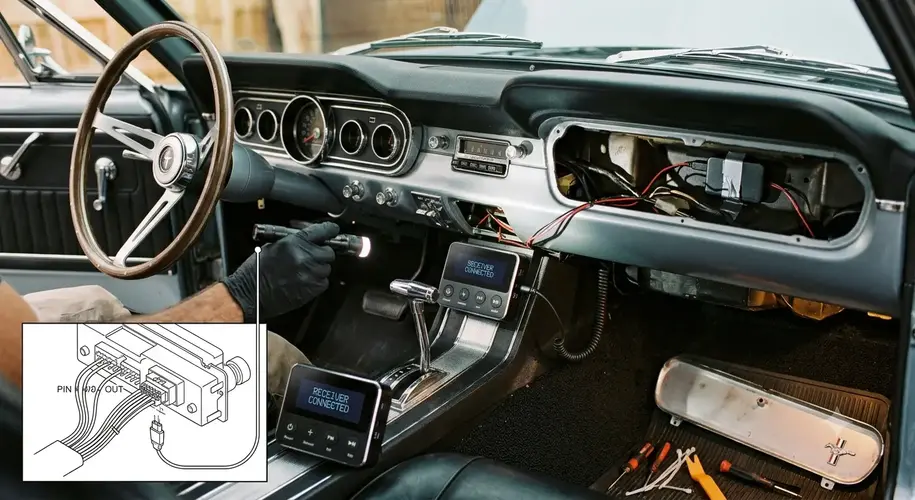
A hidden Bluetooth receiver adds wireless audio without requiring the original radio to be internally modified.
The receiver may be installed:
- Behind the dashboard
- Inside the glovebox
- Beneath the dash
- Under a seat
- Behind an interior panel
- Near a concealed amplifier
The original radio can remain visible and functional, remain disconnected, or operate separately from the hidden system.
This makes a concealed receiver useful when the original radio is rare, valuable, nonfunctional, or too important to alter.
Bluetooth may be controlled through:
- A paired phone
- Hidden push buttons
- A glovebox-mounted control
- A discreet under-dash switch
- A concealed wired remote
The selected location should provide secure mounting, ventilation, service access, and protection from moisture or accidental damage.
Wiring should remain organized and reversible whenever practical.
Option 3: Use a Factory-Look Bluetooth Stereo
A factory-look stereo is a modern replacement designed to fit or resemble the original radio location.
Depending on the model, it may include:
- Bluetooth streaming
- USB or AUX input
- Updated AM/FM operation
- Vintage-style knobs and face design
- Additional speaker outputs
- Hands-free calling on equipped models
This option is generally best when the original radio is missing, incorrect, severely damaged, or not part of the vehicle’s restoration goal.
Before installation, confirm:
- Knob spacing
- Dashboard-opening dimensions
- Mounting depth
- Bezel and trim compatibility
- Vehicle voltage and polarity
- Speaker impedance
- Power and grounding requirements
A factory-look stereo can preserve the general period appearance, but it is not the same as retaining the original radio.
Fitment should be verified for the exact vehicle and dashboard rather than relying only on advertised dimensions.
For help comparing restoration, conversion, and replacement, read our classic car radio restoration vs. replacement guide.
Can the Speakers Remain Hidden?
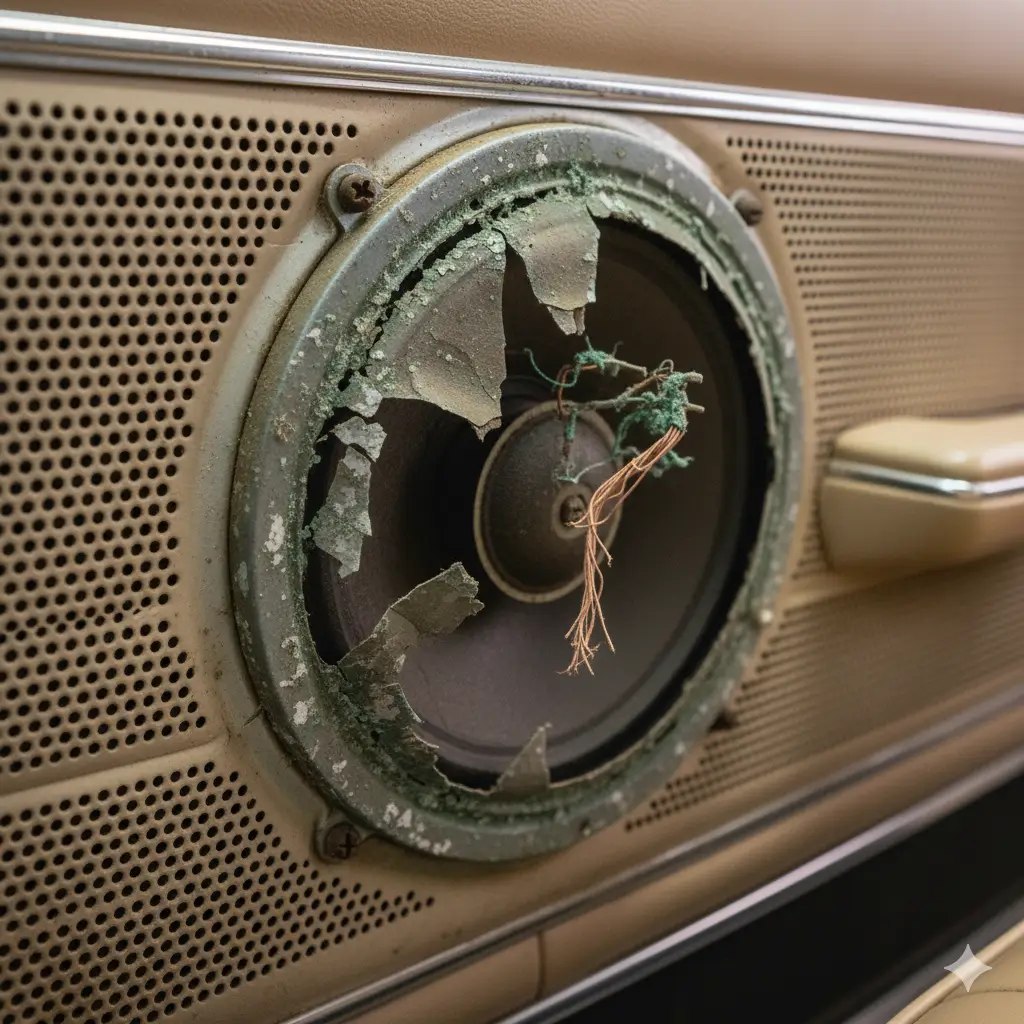
Yes. Speakers can often be repaired, replaced, or upgraded without visibly changing the interior.
Possible approaches include:
- Reusing factory speaker locations
- Installing compatible speakers behind original grilles
- Reconing repairable original speakers
- Rebuilding original speaker housings
- Adding concealed rear or under-seat speakers
- Installing a hidden amplifier or subwoofer
Speaker selection should account for size, mounting depth, rated impedance, radio or amplifier output, and available space.
A Bluetooth receiver alone will not improve sound if the existing speakers are damaged, disconnected, or incompatible.
The speakers and wiring should be inspected before the system is designed.
Does a Bluetooth Upgrade Require an Amplifier?
Not always. An amplifier may be unnecessary when the converted radio provides sufficient output, the vehicle has a simple speaker arrangement, and moderate listening volume is acceptable.
A concealed amplifier may be useful when:
- Multiple speakers are being installed
- Higher volume or greater clarity is desired
- A subwoofer is included
- The receiver does not directly power speakers
- The original radio will not power the modern system
The amplifier may be hidden beneath a seat or behind an interior panel.
It should have secure mounting, correct power wiring, proper grounding, appropriate fuse protection, ventilation, and service access.
Can Bluetooth Be Added to a 6-Volt Classic Car?
Sometimes, but compatibility must be confirmed before connecting modern equipment.
Many Bluetooth receivers, amplifiers, and modern radios are designed for 12-volt negative-ground electrical systems.
A vehicle with a 6-volt or positive-ground system may require compatible equipment, isolated power, voltage conversion, or other electrical adaptation.
An evaluation should confirm:
- Actual system voltage
- Ground polarity
- Charging-system condition
- Available current
- Equipment requirements
- Fuse protection
- Speaker compatibility
Do not assume the electrical configuration is original based solely on the vehicle’s year.
Some classics have been converted and may contain a mixture of original and modern wiring.
Why Should You Avoid Cutting the Dashboard?
Cutting is usually unnecessary because conversion, concealed receivers, and properly fitted factory-look radios can provide Bluetooth without enlarging the original radio opening.
Permanent modifications may:
- Damage rare trim or bezels
- Remove the factory mounting arrangement
- Leave visible alteration marks
- Make future radio restoration more difficult
- Reduce appeal to originality-focused buyers
When possible, use original mounting points, reversible wiring, concealed controls, and compatible equipment. Retain any removed radio, knobs, brackets, connectors, and hardware with the vehicle.
Will Adding Bluetooth Fix Static or No Sound?
Not necessarily. Bluetooth provides another audio source, but it does not repair failed speakers, damaged wiring, weak grounds, electrical interference, incompatible components, or an internal radio-output fault.
If the existing system has static, weak output, distortion, intermittent sound, or no sound, diagnose it before adding Bluetooth.
Otherwise, the new source may reproduce the same problem.
See why a classic car radio may have static or no sound for symptom-specific diagnostic guidance.
What Should Be Inspected Before Installation?
Before selecting Bluetooth equipment, determine:
- Whether the existing radio is original, period-correct, or aftermarket
- Whether the dashboard opening, bezel, and trim remain intact
- Whether the installation can be serviced or reversed later
- Which modern features the owner actually wants
An inspection-first approach prevents incompatible equipment, unnecessary dashboard modifications, and new components being installed into a damaged audio system.
For pricing factors, review our classic car audio restoration cost guide.
Classic Car Bluetooth Installation in Huntington Beach
Coastline Classic Car Restorations having 14 years of experience evaluates discreet Bluetooth options for classic cars in Huntington Beach and throughout Orange County.
We inspect the radio, dashboard, speakers, wiring, grounds, electrical configuration, previous modifications, and available hidden component locations.
Based on those findings, the appropriate solution may be an original-radio conversion, hidden receiver, factory-look stereo, concealed amplifier, or compatible speaker upgrade.
Call (657) 540-8792 or request a classic car Bluetooth audio evaluation or visit our classic car audio restoration page.
Frequently Asked Questions
Can Bluetooth be added to an original classic car radio?
Yes. Many original radios can be internally converted or paired with a separate hidden receiver while retaining the factory face, knobs, bezel, and dashboard opening.
Can the original radio remain in the dashboard?
Yes. A concealed Bluetooth receiver can operate separately while the original radio remains visible, functional, disconnected, or electronically untouched.
Does a hidden Bluetooth receiver require an amplifier?
It depends on the receiver and speaker system. Some receivers require a separate amplifier, while converted radios or powered systems may provide sufficient output.
Can Bluetooth be added to a 6-volt or positive-ground car?
Sometimes. The vehicle’s voltage, polarity, charging system, and equipment requirements must be confirmed before installation. Compatible equipment or electrical adaptation may be required.