

Common signs of head-gasket failure in a classic car can include:
- Persistent white exhaust after warm-up
- Unexplained coolant loss or overheating
- Cooling-system bubbles
- Low compression in adjacent cylinders
- Coolant-contaminated oil
No single symptom confirms the cause: Pressure testing, combustion-gas testing, compression testing, and leak-down testing help investigate the leak.
Further inspection: A failed gasket may need to be distinguished from a cracked head, cracked block, or another fault.
What Does a Head Gasket Do?
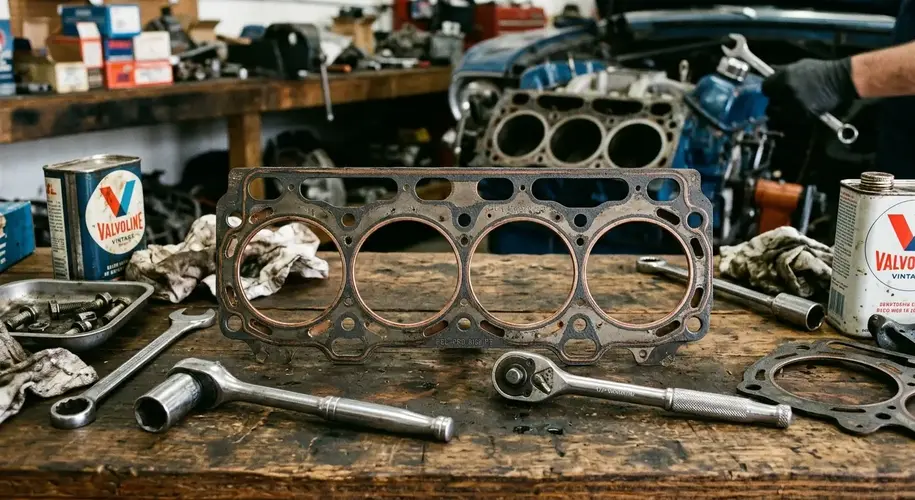
The head gasket seals the joint between the cylinder head and engine block, containing combustion pressure and separating coolant and oil passages.
Symptoms depend on the failure path:
- Cylinder to coolant: Cooling-system pressure, coolant loss, or overheating.
- Cylinder to cylinder: Low compression and misfires in adjacent cylinders.
- Coolant to oil: Contaminated engine oil.
- External edge: Visible oil or coolant leakage.
Common Symptoms of Head-Gasket Failure
Persistent White Exhaust Smoke
Temporary cold-start vapor may be condensation. White exhaust that persists after warm-up warrants investigation for coolant entering a cylinder.
Supporting clues include:
- Unexplained coolant loss
- Rough running or misfires
- A sweet exhaust odor
- An unusually clean spark plug compared with the others
These clues do not confirm gasket failure. A cracked head or block and certain intake-manifold leaks can produce similar symptoms.
Coolant Loss, Bubbling, or Unusual Cooling-System Pressure
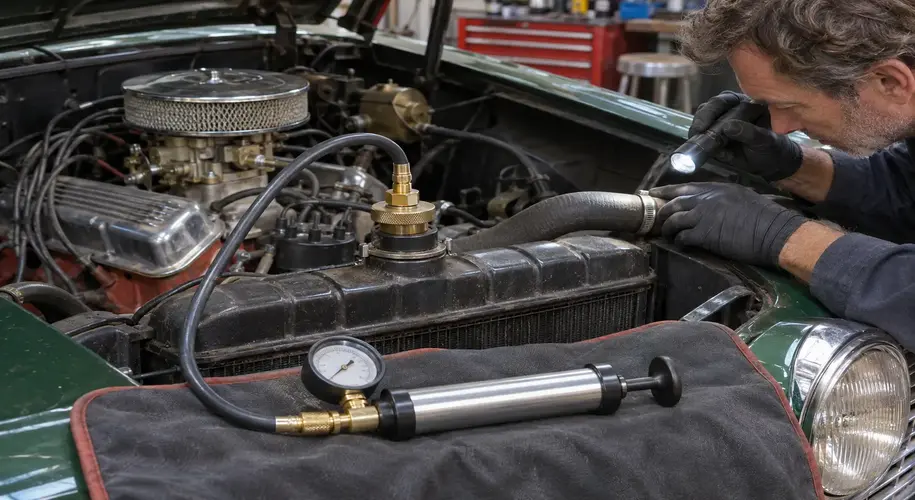
A combustion-to-coolant leak may cause:
- Coolant loss or repeated overflow discharge
- Persistent bubbling
- Unusually rapid pressure buildup
Similar symptoms can have other causes: External leaks, trapped air, low coolant, and localized boiling can produce overlapping signs. These symptoms alone do not establish gasket failure.
What to check first: Inspect the radiator, hoses, heater core, water pump, intake manifold, and core plugs for external leaks. An internal leak may leave no visible puddle.
Next diagnostic step: If external checks do not explain the loss, cooling-system pressure testing and combustion-gas testing can help investigate an internal leak.
Safety: Never remove a radiator cap while the cooling system is hot or pressurized.
Repeated Overheating
Overheating can cause head-gasket failure or result from combustion gases entering the cooling system.
Other causes to investigate:
- Radiator restrictions or inadequate airflow
- Thermostat or water-pump faults
- Incorrect timing or fuel-mixture problems
Overheating alone does not confirm gasket failure.
Low Compression and Misfires
Gasket failure between two cylinders can cause similarly low compression readings in adjacent cylinders.
Associated symptoms: Misfires, rough running, or reduced power.
Other possible causes: Leaking valves, piston damage, worn rings, or camshaft problems can also reduce compression.
Adjacent low readings raise suspicion but do not confirm the diagnosis.
Milky or Contaminated Oil
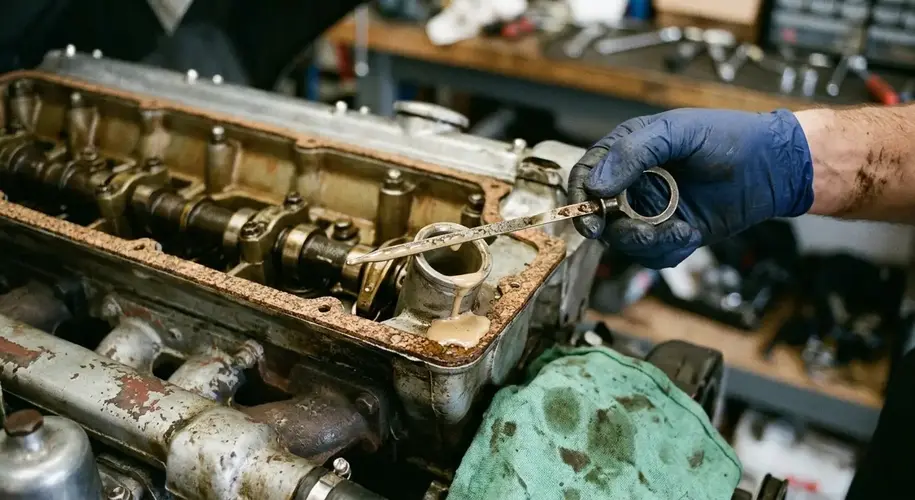
Coolant contamination may give engine oil a milky, tan, or foamy appearance. It compromises lubrication, putting bearings, crankshaft journals, camshaft surfaces, and other lubricated components at risk.
A little beige residue under the filler cap can result from short-trip condensation. Contamination on the dipstick or an unexplained rise in oil level is more concerning and requires investigation before further operation.
Why Head Gaskets Fail in Classic Cars
Common causes include:
- Overheating: Excessive heat can distort the cylinder head and damage the gasket.
- Age and corrosion: Deteriorated gasket materials and corroded sealing areas can lose their ability to seal.
- Damaged sealing surfaces: Warpage, erosion, or an unsuitable surface finish can prevent reliable sealing.
- Installation errors: Incorrect gasket orientation, surface preparation, fastener torque, or tightening sequence can cause failure.
- Abnormal combustion: Detonation and excessive cylinder pressure can overload the seal.
- Incorrect gasket selection: The design must suit the engine, casting materials, and intended use.
How Is Head-Gasket Failure Diagnosed?
| Test or inspection | What it helps establish | What it cannot establish alone |
|---|---|---|
| External leak and fluid inspection | Whether coolant loss is visible and whether oil or coolant appears contaminated | The source of every internal leak |
| Cooling-system pressure test | Whether the system loses pressure under the test conditions | Whether every pressure loss comes from a head gasket |
| Combustion-gas test | Whether combustion gases are detected in the cooling system | Whether the leak passes through a gasket or cracked casting |
| Compression test | Whether cylinder pressures are low or uneven, including adjacent-cylinder patterns | The exact leakage path |
| Leak-down test | Where air escapes from a pressurized cylinder | Whether a coolant-side leak is caused by the gasket, head, or block |
| Inspection after head removal | Gasket damage and the condition of sealing surfaces and castings | Damage elsewhere in the engine without additional inspection |
During leak-down testing, air escaping at the intake or exhaust suggests valve leakage; air entering the crankcase may indicate ring or cylinder leakage.
Bubbles in the cooling system suggest a cylinder-to-coolant connection, but do not distinguish a failed gasket from a cracked casting.
For the cylinder-testing procedure and recording method, see how to perform a compression test on a classic car engine.
If cylinder-head removal is recommended, ask which findings support it and what inspections will follow. Fel-Pro’s comparison of cracked heads and failed head gaskets explains why removal and machine-shop pressure testing may be needed to distinguish the causes of overlapping symptoms.
Can You Drive With a Blown Head Gasket?
Do not continue driving with suspected head-gasket failure, particularly if the engine is overheating or coolant is contaminating the oil.
Continued operation can damage bearings, cylinders, and castings or cause hydrolock.
Stop the engine if:
- Temperature rises rapidly
- Oil pressure drops
- Coolant mixes with the oil
- Heavy white exhaust persists after warm-up
Arrange an inspection before restarting.
Is Gasket Repair Enough, or Is Rebuilding Required?
A head-gasket repair may be sufficient when:
- Damage is limited to the gasket
- The block and cylinder head are crack-free
- Sealing surfaces can be restored
- Bearings and cylinder walls remain healthy
- The original cause is corrected
Broader engine rebuilding may be necessary when:
- Coolant-contaminated oil has damaged bearings
- Severe overheating has damaged rings or cylinders
- The head or block requires extensive repair
If major internal work is confirmed, review engine rebuild versus replacement before selecting the final repair strategy.
Our shop’s approach: We investigate what caused the leak. Replacing the gasket without correcting overheating or damaged sealing surfaces can lead to another failure.
Choosing the Correct Replacement Gasket
Composite and multi-layer steel (MLS) gaskets have different material, surface-finish, and fastener requirements. MLS is not automatically better for every classic engine.
Gasket selection should be based on:
- Engine design
- Block and cylinder-head materials
- Surface flatness and finish
- Compression and intended use
- Manufacturer specifications
- Required fasteners and torque procedure
Pour-in gasket sealers are not a substitute for mechanical repair and may restrict cooling-system passages or complicate later service.
Have a Suspected Head-Gasket Problem Evaluated
Share these details with our Huntington Beach shop:
- Engine symptoms
- Overheating history
- Available test results
Owner Chuck brings more than 14 years of classic car restoration experience to discussing repair options.
If inspection indicates broader damage, explore our engine rebuilding and restoration services in Huntington Beach.