

Rebuild the original transmission when matching numbers, factory accuracy, or collector originality is the priority.
Consider an overdrive conversion when the car is regularly driven on freeways and lower cruising RPM is more important than retaining its original drivetrain configuration.
Owners who want both benefits may consider a reversible overdrive conversion while retaining the original transmission for future restoration or reinstallation.
The right choice depends on the vehicle’s significance, engine characteristics, rear axle ratio, tire size, intended use, and the modifications required for installation.
Original Transmission or Overdrive: Quick Comparison
| Owner’s priority | Option to consider |
|---|---|
| Matching-numbers preservation | Rebuild the original transmission |
| Factory-correct or concours restoration | Rebuild the original transmission |
| Original driving characteristics | Rebuild the original transmission |
| Frequent freeway driving | Consider an overdrive conversion |
| Lower highway RPM | Consider an overdrive conversion |
| Pro-touring or restomod build | Modern automatic or manual overdrive |
| Originality with added highway gearing | Auxiliary overdrive or reversible conversion |
| Uncertain future plans | Retain and store the original transmission |
This is a planning guide—not a universal recommendation. The complete vehicle should be evaluated before selecting a transmission.
How Does Overdrive Change Highway RPM?
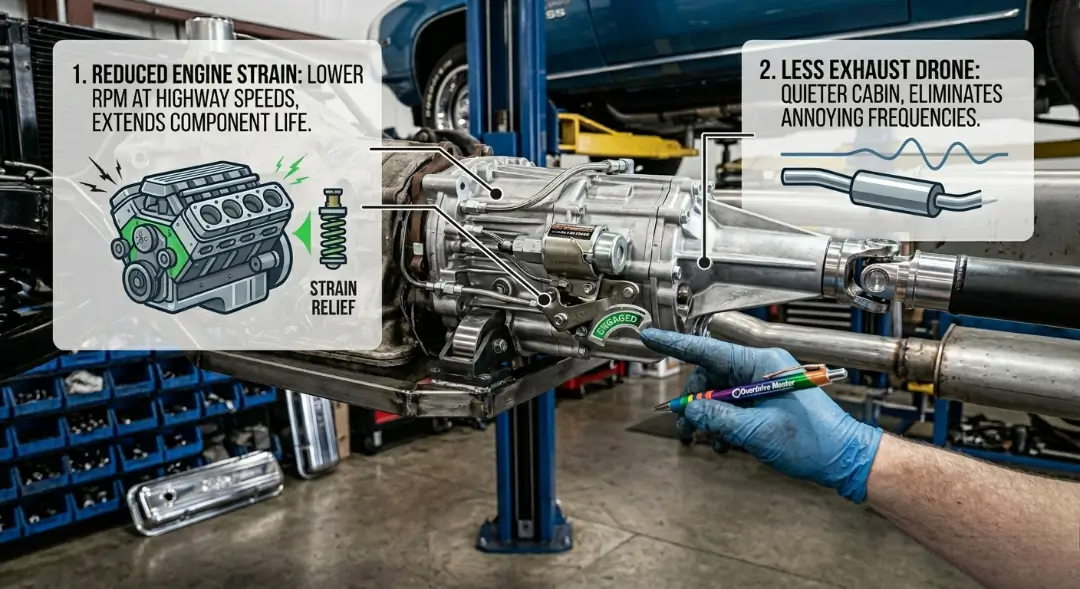
Many classic transmissions use a 1.00:1 direct-drive top gear. An overdrive transmission uses a top-gear ratio below 1.00:1, allowing the engine to turn fewer revolutions at the same road speed.
Cruising RPM depends primarily on:
- Vehicle speed
- Transmission gear ratio
- Rear axle ratio
- Tire diameter
Torque-converter slip or lockup operation can also affect actual engine speed in an automatic transmission.
Example Highway RPM Comparison
This example assumes:
- 70 mph
- 3.73 rear axle ratio
- 27-inch tire diameter
- 1.00:1 top gear for the TH350
- 0.70:1 overdrive for the 700R4
| Transmission | Top-gear ratio | Calculated RPM at 70 mph |
|---|---|---|
| TH350 | 1.00:1 | 3,250 RPM |
| 700R4 | 0.70:1 | 2,275 RPM |
In this example, switching from the TH350’s 1.00:1 top gear to the 700R4’s 0.70:1 overdrive lowers calculated engine speed at 70 mph from approximately 3,250 to 2,275 RPM—a reduction of about 975 RPM, or 30%.
These are theoretical figures. Actual automatic-transmission engine speed may be higher because of torque-converter slip unless the converter is locked.
Tire size, axle ratio, transmission specifications, and vehicle setup also affect the final result.
Lower RPM may reduce highway noise and fuel consumption when the gearing matches the engine’s operating range.
However, gearing that is too tall can cause engine lugging, frequent downshifts, poor converter behavior, or unsatisfactory drivability.
When Should You Rebuild the Original Transmission?
Rebuilding the original transmission often makes sense for:
- Matching-numbers vehicles
- Rare muscle cars
- Survivor vehicles
- Concours restorations
- Historically significant cars
- Owners who prefer factory driving characteristics
Potential benefits include:
- Preserving original components
- Maintaining casting and identification numbers
- Avoiding permanent installation modifications
- Retaining period-correct operation
- Supporting documented originality
The tradeoff is that a non-overdrive transmission may produce higher engine RPM during sustained freeway driving, depending on the rear axle ratio and tire diameter.
When Should You Consider an Overdrive Conversion?
An overdrive conversion may be appropriate when:
- The vehicle is regularly driven at freeway speeds
- Long-distance drivability matters more than factory originality
- The vehicle is already modified
- The build is intended as a restomod or pro-touring car
Overdrive does not automatically improve every classic car. The replacement transmission must be compatible with the engine’s torque, rear gearing, vehicle weight, tire size, cooling system, and intended use.
Common Classic Car Overdrive Options
700R4 Automatic
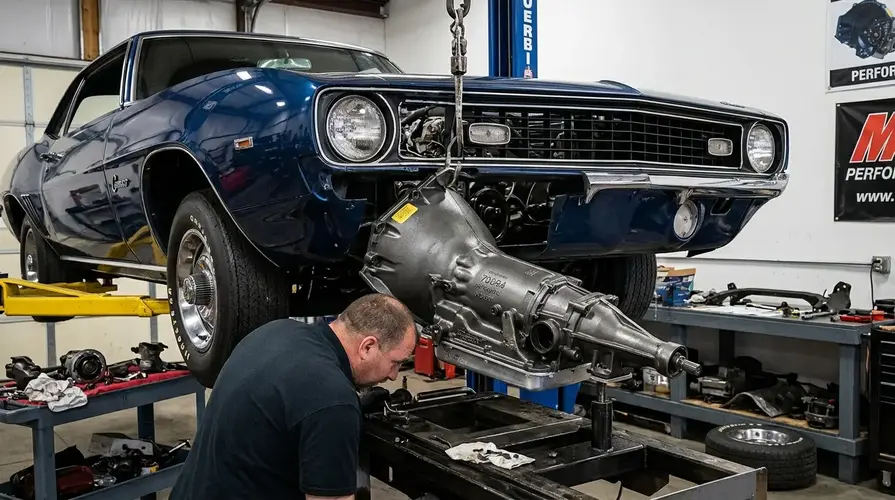
The 700R4 is a common GM conversion with a 0.70:1 fourth gear, a deep 3.06:1 first gear, lockup-converter capability, and broad aftermarket support.
Correct throttle-valve cable geometry and adjustment are critical because they affect line pressure and shift operation. Incorrect setup can cause poor shifting and rapid transmission damage.
200-4R Automatic
The 200-4R is another GM automatic-overdrive option.
It may provide favorable fitment in certain applications, but torque capacity, crossmember position, driveshaft length, converter controls, gearing, and parts support must be verified.
Tremec Manual Transmission
Tremec five- and six-speed transmissions are frequently considered for performance-oriented classics, restomods, and pro-touring builds.
Compatibility depends on the specific transmission and vehicle. Bellhousing, clutch operation, tunnel clearance, crossmember location, driveshaft length, shifter position, and speedometer operation may require changes.
Auxiliary Overdrive
An auxiliary overdrive can add highway gearing behind an existing transmission. This may allow the original gearbox to remain in the car, but it is not necessarily modification-free.
Clearance, mounting, driveshaft length, wiring, controls, speedometer operation, and driveline angles must still be evaluated.
What Must Be Checked to Avoid Conversion Problems?
A transmission should not be selected based on its overdrive ratio alone.
| Area | What must be verified | What can go wrong |
|---|---|---|
| Engine and gearing | Torque range, axle ratio, tire size, and cruising RPM | Lugging, poor acceleration, or frequent downshifts |
| Transmission | Torque capacity for the engine, vehicle weight, traction, and intended use | Premature wear or failure |
| Converter or clutch | Stall speed, lockup, clutch capacity, and controls | Excess heat or poor engagement |
| Driveshaft | Length, balance, yoke engagement, and operating angles | Vibration or component wear |
| Fitment | Crossmember, tunnel, shifter, and exhaust clearance | Interference or weak fabrication |
| Cooling | Cooler capacity, airflow, and line routing | Overheating and fluid breakdown |
| Controls | TV cable, lockup wiring, electronics, and speedometer | Poor shifts or incorrect operation |
| Reversibility | Original parts and permanent modifications | Reduced future restoration options |
Installation and component-matching errors—not merely the transmission choice—often cause problems after a conversion.
New vibration should be diagnosed as a complete driveline problem rather than automatically blamed on the transmission. See our guide to diagnosing classic car driveline vibration.
Will an Overdrive Swap Affect Classic Car Value?
A reversible, properly documented conversion may appeal to buyers who prioritize drivability, but it does not guarantee a higher resale value.
Originality generally matters more for:
- Matching-numbers cars
- Rare survivor vehicles
- Concours restorations
- Historically significant vehicles
Permanent tunnel modifications, poor fabrication, missing original components, wiring problems, and unresolved vibration may reduce buyer confidence. Retaining the original transmission and documenting the conversion preserves more future options.
Learn more about how transmission restoration and modification may affect classic car resale value.
What Should Be Inspected Before Choosing a Transmission?
Before choosing between an original rebuild and an overdrive conversion, the complete vehicle should be evaluated—not just the transmission currently installed.
At Coastline Classic Car Restorations, our evaluation may include:
- Transmission identification and originality
- Tunnel and shifter clearance
- Cooling capacity
- Intended driving conditions
- Reversibility of proposed modifications
In our experience, driveline angles, cooling capacity, TV-cable geometry, converter operation, and rear gearing should be verified as part of the complete installation—not treated as secondary details after the transmission is installed.
For Southern California classics regularly driven on I-405, I-5, CA-55, or other freeways, sustained cruising conditions deserve particular attention.
For a collector-focused vehicle driven mainly at events or on shorter local trips, retaining the factory transmission may remain the better fit.
The recommendation should reflect how the car is built, driven, and valued—not simply whether an overdrive transmission can physically fit.
Bottom Line: Should You Rebuild or Upgrade?
Choose based on the car’s intended use and significance.
A collector-focused vehicle generally benefits from retaining its original transmission, while a regularly driven classic may benefit from properly matched overdrive gearing.
When both originality and highway comfort matter, a reversible conversion with the original components retained provides the most future flexibility.
Frequently Asked Questions
Can a classic car be driven on the freeway without overdrive?
Yes. Many classic cars can operate at freeway speeds without overdrive. Comfort, noise, fuel use, and engine RPM depend on the axle ratio, tire size, vehicle condition, and cruising speed.
How much can overdrive reduce highway RPM?
The reduction depends on the overdrive ratio. Changing from a 1.00:1 top gear to a 0.70:1 overdrive theoretically reduces cruising RPM by approximately 30% when the axle ratio, tire diameter, and road speed remain unchanged.
Should I keep the original transmission?
For a matching-numbers, rare, or collector-focused vehicle, retaining the original transmission is generally prudent even if a reversible overdrive conversion is installed.
Classic Car Transmission and Overdrive Services in Huntington Beach
At Coastline Classic Car Restorations in Huntington Beach, California, having 14+ years of experience, we help owners compare factory-original transmission restoration with properly planned overdrive conversions.
Learn more about our classic car transmission and driveline restoration services to discuss your vehicle, drivetrain configuration, and restoration goals.