

Classic car upholstery restoration may cost approximately $700 to $2,500 or more per seat and $1,400 to $4,000 or more for a front-seat pair.
A broader upholstery package covering front and rear seats, upholstered panels, the headliner, foam, padding, and structural seat repairs may cost several thousand dollars, depending on the vehicle and project scope.
The final price depends on the condition of the seat frames, springs, support systems, foam, padding, existing upholstery, door panels, and headliner, as well as the materials selected and the level of originality required.
Classic Car Upholstery Costs at a Glance
| Upholstery project | Broad planning range | Typical scope |
|---|---|---|
| Localized upholstery repair | $250–$1,000+ | Seam, piping, insert, or individual panel repair |
| Single-seat restoration | $700–$2,500+ | Cover, foam, padding, and limited support repair |
| Front-seat pair | $1,400–$4,000+ | Two bucket seats or one front bench |
| Headliner restoration | $500–$2,400+ | Bow-style installation or headliner-board recovery |
| Door and quarter panels | $700–$3,000+ | Recovering, rebuilding, or replacing upholstered panels |
| Complete upholstery package | $7,500–$16,000+ | Seats, upholstered panels, headliner, and related soft trim |
| Factory-correct upholstery restoration | $14,000–$32,000+ | Period-correct materials, patterns, and detailed reconstruction |
A rare vehicle, missing components, extensive fabrication, or hidden structural damage can move the price outside these ranges.
What Is Included in an Upholstery Restoration Quote?
An upholstery quote may cover only replacement covers, or it may include rebuilding the seats and restoring related upholstered surfaces.
Depending on the project, the scope may include:
- Front and rear seat covers
- Seat foam and traditional padding
- Springs, straps, and seat-frame repairs
- Upholstered door and quarter panels
- Bow-style or board-style headliners
- Sail panels and pillar upholstery
- Windlace, piping, and bindings
- Clips, listing wires, and attachment hardware
- Removal, documentation, and reinstallation
Floor insulation, dashboard work, electrical repairs, and other broader interior-restoration services may be quoted separately.
Before comparing estimates, confirm whether the price includes materials, structural seat repairs, installation, and all related upholstered components. A lower quote may simply cover a narrower scope.
How Much Does Classic Car Seat Restoration Cost?
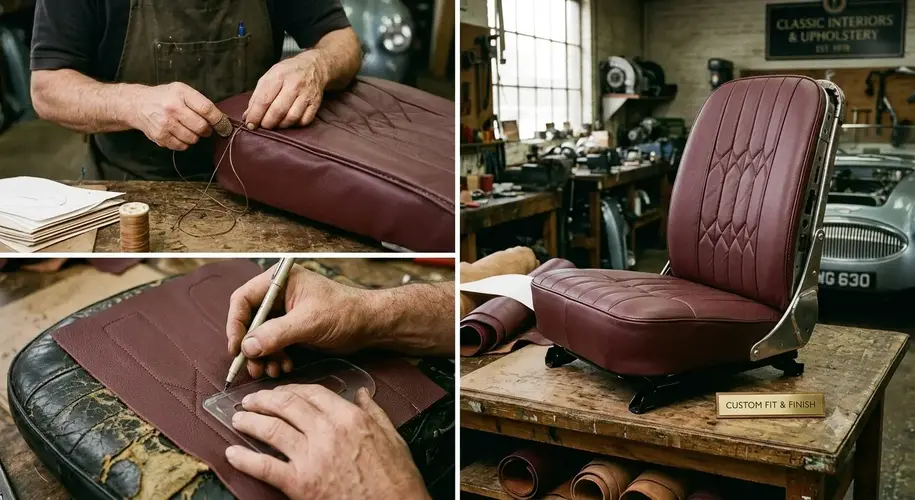
Restoring a classic car seat commonly costs approximately $700 to $2,500 or more per seat.
The price depends on whether the seat needs only a replacement cover or a complete structural and cushion rebuild.
A seat restoration may require:
- Reproduction or custom-made upholstery
- New molded foam
- Spring or support-strap repairs
- Frame welding or straightening
- Burlap, felt, and listing wires
- New piping and attachment hardware
- Track or recliner repairs
- Pattern development when covers are unavailable
Seats are often one of the largest parts of the upholstery budget because the visible cover cannot be installed correctly until the shape and support underneath are restored.
A seat that appears to need only new upholstery may reveal broken springs, collapsed foam, rust, or previous repairs after disassembly.
How Do Upholstery Materials Affect the Price?
Material selection affects both the supply cost and the labor required to produce a correct fit.
Vinyl
Automotive vinyl is often the most economical choice and may be factory correct for many classic vehicles. Cost depends on the grain, backing, color, stretch, and availability of a vehicle-specific reproduction.
Cloth
Standard automotive cloth may be reasonably priced. Rare houndstooth, plaid, velour, woven, or model-specific patterns can cost more to source. Pattern matching may also require additional material and careful cutting.
Leather
Leather usually costs more because hides vary in usable area, grain, color, finish, and quality. Matching panels and cutting around natural imperfections can increase material waste and labor.
Period-correct materials
Factory-style grain, perforation, piping, cloth weave, sheen, and stitching may cost more than generic upholstery. These attributes become particularly important for originality-focused or judged vehicles.
The most expensive material is not automatically the correct choice. A vehicle originally equipped with vinyl or cloth may become less authentic if every upholstered surface is converted to leather.
Why Does Factory-Correct Upholstery Cost More?
Factory-correct upholstery restoration requires more research, documentation, sourcing, and detail than a general seat recover or driver-quality refresh.
The shop may need to reproduce:
- Original trim codes
- Material grain and sheen
- Cloth weave and pattern scale
- Perforation
- Pleat spacing
- Seat-panel construction
- Piping and stitching
- Door-panel upholstery
- Headliner style
- Material placement throughout the cabin
Original covers and upholstered panels may need to be carefully disassembled and used as patterns. Rare materials may require special ordering or matching from protected original samples.
A driver-quality upholstery package can prioritize durability, comfort, and a period-appropriate appearance.
A concours restoration may require details that are not immediately noticeable to a casual observer.
Why Can Two Similar Classic Cars Receive Different Quotes?
Two vehicles of the same year and model may require very different amounts of upholstery work.
One car may have:
- Sound seat frames
- Reusable foam
- Complete trim
- Available reproduction covers
- Serviceable door-panel boards
- A complete headliner system
Another may have:
- Broken springs
- Collapsed cushions
- Rusted tracks
- Missing brackets
- Water-damaged panels
- Incorrect previous upholstery
- Unavailable materials
- Custom modifications that must be reversed
Visible wear does not always reveal what is damaged underneath. An estimate based only on exterior photographs may change after the seats, covers, or surrounding trim are removed.
What Additional Costs Should You Ask About?
A quoted upholstery price may not include every related repair or service.
Ask whether the estimate covers:
- Seat and upholstered-trim removal
- Foam, springs, straps, and padding
- Frame or track repair
- Clips and mounting hardware
- Material shipping and freight
- Rust or moisture damage
- Glass removal for headliner installation
- Custom pattern development
- Color and material matching
- Outside subcontractor work
- Carpet installation
Services outside the upholstery scope may include:
- Floor rust repair
- Insulation and sound-deadening
- Dashboard restoration
- Electrical repairs
- Gauge or audio work
- Interior paint and hard-trim refinishing
For example, a quote for replacement seat covers may exclude foam, structural repairs, and installation. A headliner quote may not include windshield or rear-glass removal.
Clear inclusions and exclusions make estimates easier to understand and compare.
Which Upholstery Budget Applies to Your Vehicle?
Driver-quality upholstery
A driver-quality project is intended for a regularly used classic. It usually focuses on clean installation, durability, comfort, and a period-appropriate appearance.
Reproduction covers and materials may be used when they fit correctly and remain visually appropriate for the vehicle.
Factory-correct upholstery
This level prioritizes original materials, patterns, grain, stitching, piping, panel placement, and construction. It is most relevant to originality-focused, valuable, or judged vehicles.
Custom restomod upholstery
A custom upholstery project may include redesigned seats, fabricated door panels, custom consoles, premium leather, contrast stitching, and discreet comfort upgrades.
Custom work can cost more than factory restoration because it may require design development, fabrication, test fitting, and one-off pattern creation.
How Can You Control Upholstery Restoration Costs?
The most effective way to control the budget is to define the restoration goal before materials are ordered or work begins.
Helpful steps include:
- Decide whether the car is a driver, survivor, concours restoration, or restomod
- Inspect seat frames and support systems before ordering covers
- Confirm the availability of period-correct materials early
- Preserve usable original trim, hardware, and upholstery samples
- Complete related upholstery work while the seats and trim are disassembled
- Request a written scope identifying included and excluded work
- Require approval before additional repairs are performed
- Include a contingency for hidden damage.
Installing inexpensive covers over damaged foam, springs, or seat frames may reduce the initial invoice, but it can lead to duplicated labor when the upholstery must be removed again.
Frequently Asked Questions
Can a classic car upholstery shop provide an exact price from photographs?
Photographs may help establish a preliminary range, but they may not reveal collapsed foam, broken springs, rusted tracks, damaged panel boards, or previous repairs beneath the upholstery.
A more accurate estimate usually requires inspecting the vehicle or disassembled components.
Is it cheaper to buy reproduction seat covers and have them installed?
It can be, particularly when correctly fitting reproduction covers are available and the seat frames, foam, and support systems remain serviceable.
The total cost may increase if the covers require adjustment or hidden structural and cushion damage is found after removal.
Does restoring original upholstery cost more than replacing it?
Sometimes. Preserving original leather, vinyl, cloth, piping, or panels may require careful removal, cleaning, reinforcement, material matching, and localized repair.
Replacement may be more predictable when accurate reproductions are available, but it may not provide the same originality.
Should an upholstery estimate include a contingency for hidden damage?
Yes. Classic seats and upholstered panels can conceal deteriorated foam, broken supports, rust, missing hardware, and previous modifications.
The estimate should explain how additional work will be documented, approved, and priced if hidden damage is discovered.
Classic Car Upholstery Estimates in Huntington Beach
Coastline Classic Car Restorations evaluates classic, vintage, collector, and restored vehicle upholstery in Huntington Beach and throughout Orange County.
Our upholstery evaluation may consider:
- Seat-cover condition and material
- Seat frames, springs, straps, foam, and padding
- Upholstered door and quarter panels
- Headliner construction and materials
- Sail panels, pillar trim, and windlace
- Upholstery clips and attachment hardware
- Material availability
- Originality goals
- Previous upholstery repairs or modifications
- Water, rust, or structural damage affecting upholstered components
Because every classic vehicle has a different condition and restoration objective, the most reliable estimate is based on the actual upholstery materials, supporting components, and labor required.
Call (657) 540-8792 to schedule a classic car upholstery evaluation at our Huntington Beach facility.
Learn more about our Classic Car Upholstery Restoration in Huntington Beach services for seats, upholstered door panels, carpets, headliners, foam, padding, springs, and period-correct soft-trim restoration.
Related Guides:
- How to Fix Sagging or Collapsed Classic Car Seats
- How to Choose Period-Correct Classic Car Upholstery: Leather vs. Vinyl vs. Cloth
- How Long Does Classic Car Upholstery Restoration Take?
These figures are broad U.S. planning ranges—not fixed prices from Coastline Classic Car Restorations.
An accurate quote requires inspecting the vehicle and defining which upholstery, supporting components, and soft-trim surfaces need to be repaired or restored.