

Classic car transmission restoration typically takes 1 to 6 weeks, although rare or heavily damaged units may take longer.
Most standard projects require approximately 1 to 3 weeks, while a common transmission with readily available parts may take only a few business days.
Rare, matching-numbers, or heavily damaged units can require six weeks or longer.
The total timeline depends on the transmission type, internal damage, parts availability, machining, originality requirements, shop scheduling, and whether the work includes removal, reinstallation, adjustments, and road testing.
Average Classic Car Transmission Restoration Timeline
| Restoration type | Typical timeline |
|---|---|
| Limited rebuild with readily available parts and no outside specialty work | 2–5 business days |
| Standard restoration using available replacement components | 1–3 weeks |
| Extensive restoration requiring additional repairs or machining | 3–6 weeks |
| Rare or specialty restoration requiring difficult-to-source parts or extensive preservation work | 6+ weeks |
These are general planning ranges, not guaranteed Coastline completion dates.
Actual calendar time depends on whether the project involves only bench restoration or also vehicle inspection, removal, installation, fluid filling, adjustments, road testing, shipping, and outside specialty work.
What Affects the Restoration Timeline?
Transmission Type and Complexity
Manual transmissions generally have fewer internal components than automatics, which can reduce rebuild time.
However, condition and parts availability can matter more than transmission type: a manual unit needing a rare replacement gear may take longer than a common automatic with readily available parts.
Common classic manual transmissions include:
- Muncie M20, M21, and M22
- Borg-Warner T10 and Super T10
- Ford Toploader
- Chrysler A833
A manual restoration may take two business days to three weeks, depending on the condition of the gears, synchronizers, shafts, bearings, and case.
Classic automatic transmissions include:
- Turbo-Hydramatic 350 and 400
- Ford C4 and C6
- Chrysler TorqueFlite 727
- Powerglide
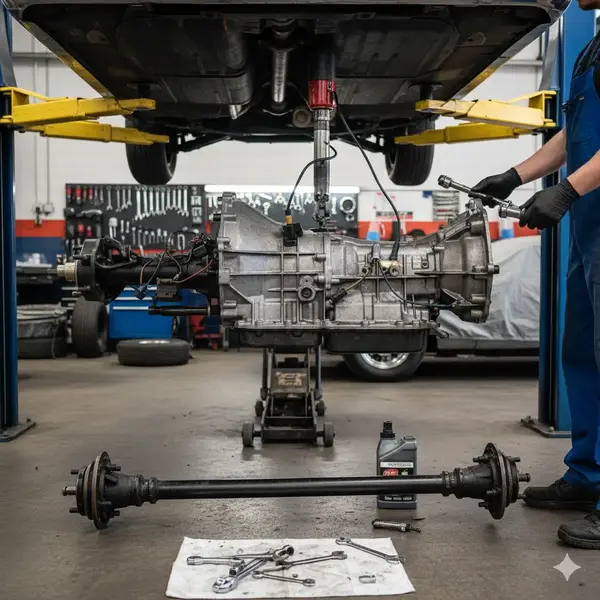
An automatic restoration may take one to six weeks because the valve body, hydraulic circuits, clutch packs, bands, planetary gearsets, bushings, and torque converter require additional inspection and testing.
Parts Availability
Common service parts such as seals, bearings, bushings, bands, and clutch packs may be readily available.
Rare gears, shafts, cases, valve-body components, and factory-correct parts can take longer to locate.
A rare transmission may require:
- New Old Stock components
- Period-correct reproduction parts
- A compatible donor transmission
- Specialty suppliers
- Custom fabrication or machining
Machining and Specialty Repairs
Damaged components may require specialty machining or technically appropriate repair involving shafts, bearing surfaces, housings, valve bodies, or torque converters.
Unserviceable gears may need to be replaced or sourced from a suitable donor transmission.
The repair itself might require only several days, but scheduling with an outside machine shop, torque-converter rebuilder, or specialty supplier can extend the overall project.
Originality Requirements
Restoring a transmission for dependable operation is not always the same as preserving a factory-original or matching-numbers unit.
An originality-focused restoration may require additional time to:
- Verify casting and identification numbers
- Preserve original housings and major components
- Locate period-correct parts
- Repair rather than replace eligible original components
- Document factory markings
- Confirm specifications and finishes
These steps can be important for historically significant or collector vehicles, but they usually take longer than a conventional rebuild.
Why Is the Timeline Preliminary Until Teardown?
External symptoms do not always reveal the transmission’s complete internal condition.
Disassembly and cleaning may uncover:
- Damaged or missing gears
- Severely worn synchronizers
- Bearing failure
- Scored shafts
- Cracked housings
- Heat or lubrication damage
- Corrosion from long-term storage
- Previous improper repairs
At Coastline classic car restorations, the initial timeline remains preliminary until the transmission has been disassembled, cleaned, and measured.
Once the internal components have been inspected, the shop can identify the required parts, machining, specialty repairs, and preservation work.
A more reliable completion estimate can then be provided, although backordered parts and outside specialty services may still affect the final date.
Teardown findings can also change the project’s price. See our guide to classic car transmission restoration costs for typical ranges and cost factors.
Bench Time vs. Total Calendar Time
Owners should distinguish between active bench time and the total project timeline.
Bench time covers disassembly, inspection, parts replacement, reassembly, and applicable testing. Total calendar time may also include:
- Owner authorization
- Parts ordering and delivery
- Machining or specialty services
- Torque-converter rebuilding
- Removal and reinstallation
- Linkage or driveline adjustments
- Road testing
- Freight transit
A rebuild that requires only several days of hands-on work may therefore take multiple weeks from arrival to final completion.
What Happens During Transmission Restoration?
A typical restoration follows these stages:
- Initial evaluation: Inspect operation, leaks, linkage, mounts, and related driveline components.
- Removal and disassembly: Remove the unit when necessary and separate its internal components.
- Cleaning and inspection: Measure components and identify wear, damage, corrosion, and incorrect tolerances.
- Estimate confirmation: Confirm required parts, repairs, cost, and revised timing.
- Parts sourcing and machining: Obtain components and complete approved specialty work.
- Reassembly: Rebuild the transmission to specification and perform applicable bench checks.
- Installation and testing: Install, fill, adjust, and road-test the transmission when included.
The estimate should explain which stages are included and when the projected completion date may be revised.
Before collecting the vehicle, ask about follow-up inspections and how to maintain a restored classic car transmission after the work is complete.
How Can Owners Help Avoid Delays?
Owners can help keep the project moving by:
- Providing the vehicle year, make, model, engine, and transmission identification
- Sharing casting numbers, tags, photographs, and previous repair records
- Explaining whether matching-numbers preservation is required
- Approving teardown and inspection promptly
- Establishing how additional repairs will be authorized
- Confirming whether the shop will receive the complete vehicle or a removed transmission
- Discussing acceptable reproduction or donor parts before work begins
Clear decisions about originality, budget, and replacement-part options can prevent the project from pausing after inspection.
If you are also considering an upgrade, compare an overdrive swap with rebuilding the original transmission before agreeing on the project scope.
Is It Faster to Ship the Transmission or Bring the Vehicle?
Neither option is automatically faster. The total time depends on freight transit, shop availability, and how removal, installation, and final testing are coordinated.
Shipping a removed transmission adds outbound and return transit time. The owner or another shop must also schedule removal, reinstallation, and checks in the vehicle.
Bringing the complete vehicle allows the restoration shop to coordinate those stages and inspect related linkage, mounts, clutch components where applicable, and the driveline.
Before choosing, confirm whether the shop accepts shipped units and ask for the expected time until the vehicle is ready to drive—not just when the transmission will be ready for collection or return shipping.
Frequently Asked Questions
Can a classic transmission be restored in one week?
Yes, some common transmissions can be completed within one week when the shop has an available work slot, damage is limited, parts are available, and no machining or specialty repair is required.
Confirm whether that estimate also includes removal, reinstallation, and road testing.
Why do some restorations take more than a month?
Rare parts, major internal damage, machining, torque-converter work, matching-numbers preservation, and outside supplier schedules can extend the project beyond one month.
Does restoration take longer than a rebuild?
It can, particularly when restoration includes authenticity verification, documentation, factory-correct parts, or preservation of original components.
Shops may use “restoration” and “rebuild” differently, so compare the included work rather than relying on the service name alone.
Does shipping time count in the estimate?
Not always. Ask whether the timeline begins when the transmission is shipped, received, inspected, approved, or placed into production.
Can an exact completion date be provided before teardown?
Usually not. Internal damage and parts requirements cannot always be confirmed until the transmission has been disassembled, cleaned, and measured.
Classic Car Transmission Restoration in Huntington Beach
At Coastline Classic Car Restorations in Huntington Beach, California, we bring more than 14 years of classic car restoration experience to evaluating your vehicle’s needs.
Transmission assessments consider internal condition, originality requirements, parts availability, and related driveline components.
Our process includes communication before and after teardown so owners understand the expected scope, timeline, and any findings that may affect completion.
Explore our classic car transmission and driveline restoration services to discuss your vehicle and restoration goals.